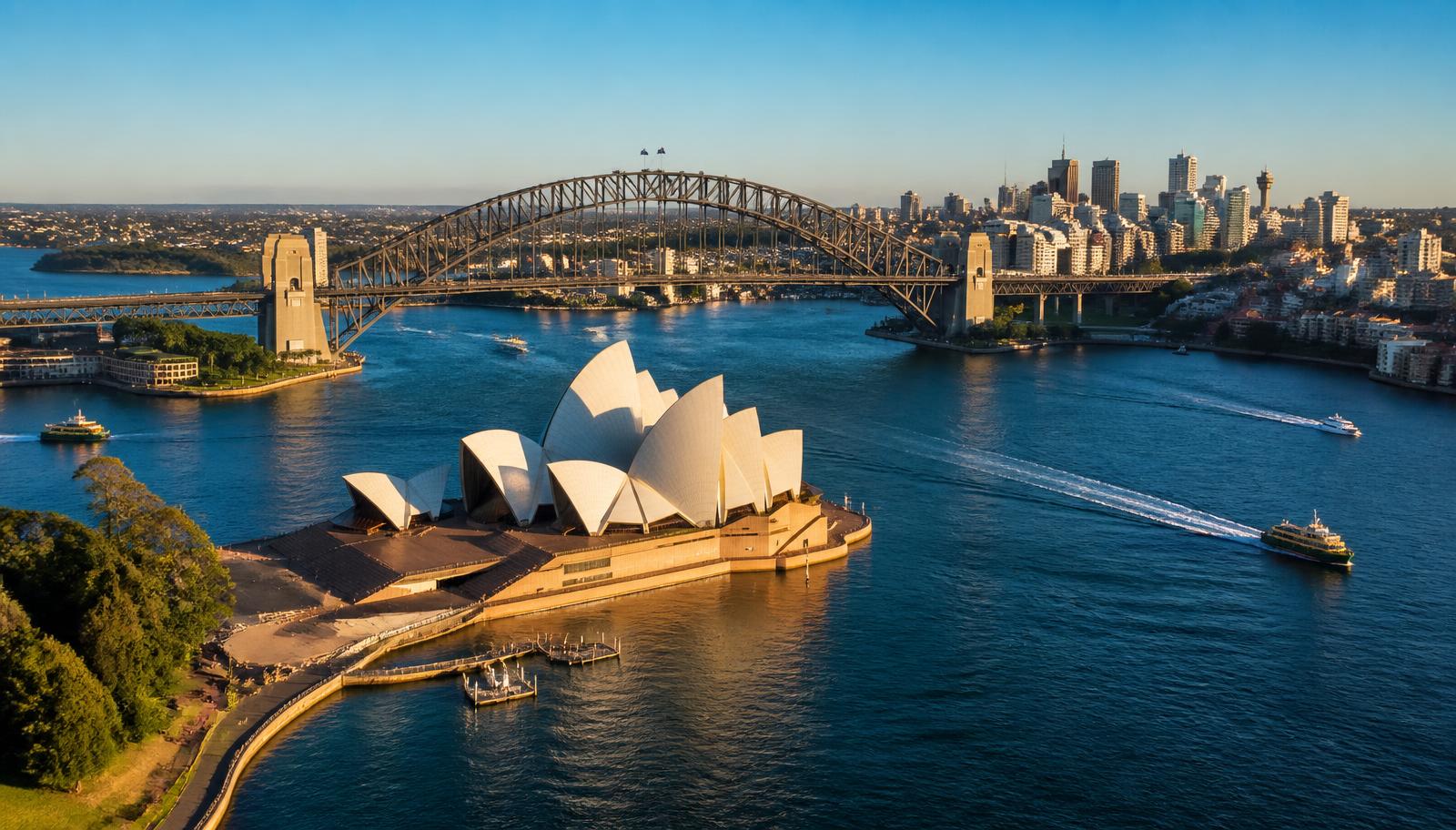
Sydney at a glance
Sydney is the city most Brits picture when they imagine Australia, and for once the picture is roughly accurate. It is the country's financial and tech capital, it has the largest population, and the harbour and beaches are genuinely woven into daily life rather than reserved for holidays. It is also the most expensive place in Australia to rent, and the gap between what you earn and what you pay for housing is the single biggest thing to plan for. If you want career options and are willing to trade space for location, Sydney is hard to beat. If your priority is saving money quickly, look at Brisbane, Perth or Adelaide first.
Typical rent
High
Highest of the five major cities
Job market
Very strong
Largest employment market in Australia
Public transport
Excellent
Trains, metro, buses, light rail, ferries
Weather
Warm summers, mild winters
Humid Jan–Feb
Lifestyle
Fast-paced + coastal
Beach culture, long commutes inland
Average commute
Around 35–45 min each way
Longer from outer suburbs
Best for
Careers, beaches, nightlife
Ambitious movers in their 20s and 30s
Cost level
Highest
Budget more for rent than anywhere else
Why people choose Sydney
- The widest choice of graduate and professional roles in Australia
- Beach swimming and coastal walks as part of ordinary weekday life
- Large British community, so the social landing is soft
- Excellent public transport by Australian standards
How it scores
- Jobs
- Affordability
- Transport
- Nightlife
- Beaches & outdoors
- Weather
- Student life
- Overall cost
Our editorial rating, comparing this city against the other Australian cities we cover.
Rent and housing
Rent is the single biggest number in your move budget, so start here.
| Property type | Indicative weekly rent | Approx. monthly (GBP) |
|---|---|---|
| Room in a shared houseOften includes bills in share listings | A$300–A$450 / week | £845 / month |
| Room in a shared apartmentInner-city apartments sit at the top of this range | A$330–A$500 / week | £935 / month |
| Studio apartment | A$480–A$650 / week | £1,273 / month |
| 1-bedroom apartment | A$550–A$780 / week | £1,498 / month |
| 2-bedroom apartmentSplit between two people this is often cheaper per head | A$750–A$1,100 / week | £2,084 / month |
Indicative ranges only — actual prices vary by suburb, property and market conditions. GBP converted at A$1 = £0.52 (indicative, September 2026).
City centre
CBD, Surry Hills, Pyrmont and Darlinghurst are the priciest per square metre. Expect small apartments, and expect to compete at inspections.
Further out
Head 30–45 minutes out — Marrickville, Ashfield, Chatswood's edges, the Inner West generally — and weekly rent typically drops noticeably for the same number of bedrooms.
- Australian rent is advertised weekly. Monthly rent is usually calculated as weekly × 52 ÷ 12, not weekly × 4.
- Expect to pay a bond (commonly four weeks' rent) plus two weeks' rent up front.
- Indicative rental prices — actual prices vary by suburb, property, furnishing and market conditions.
Where to live
The areas most new arrivals in Sydney end up considering, and who each one actually suits.
Surry Hills
Immediately south-east of the CBD
Terraced houses, small bars, cafés and creative offices
- Suits:
- Young professionals who want to walk to work and go out locally
- Transport:
- Walk to Central Station, light rail, frequent buses
- To the CBD:
- 10–20 min walk
- Food:
- One of the densest café and small-bar strips in the city
Newtown
Inner West, around 4 km from the CBD
Student-heavy, alternative, live music and vintage shops
- Suits:
- Students, creatives and anyone who wants nightlife on their doorstep
- Transport:
- Newtown station on the Inner West line, frequent buses
- To the CBD:
- 10–15 min by train
- Food:
- King Street is wall-to-wall cheap eats and international food
Bondi / North Bondi
Eastern Suburbs, on the coast
Beach-first, backpacker and expat heavy, busy year-round
- Suits:
- New arrivals who came for the beach lifestyle
- Transport:
- Bus, or train to Bondi Junction then bus
- To the CBD:
- 30–45 min
- Food:
- Brunch culture, casual dining, plenty of takeaway
- Beach:
- On Bondi Beach; Bondi-to-Coogee coastal walk starts here
Coogee
Eastern Suburbs, south of Bondi
Quieter beach suburb with a strong Irish and British contingent
- Suits:
- People who want the beach without Bondi's crowds
- Transport:
- Buses only — no train
- To the CBD:
- 35–50 min by bus
- Food:
- Relaxed pubs, cafés and casual restaurants
- Beach:
- Coogee Beach plus sheltered ocean pools
Marrickville
Inner West, around 7 km from the CBD
Warehouses turned breweries, Vietnamese and Greek food, young families
- Suits:
- People wanting inner-city access at a slightly lower price
- Transport:
- Marrickville and Sydenham stations, plus the metro at Sydenham
- To the CBD:
- 15–20 min by train
- Food:
- Illawarra Road for Vietnamese; a cluster of craft breweries
Parramatta
Greater Western Sydney, around 24 km from the CBD
Sydney's second CBD — high-rise, fast-growing, very multicultural
- Suits:
- People working in western Sydney or prioritising space and price
- Transport:
- Major train interchange, light rail, ferry to Circular Quay
- To the CBD:
- 30–40 min by express train
- Food:
- Church Street 'Eat Street' — enormous range, generally cheaper
Chatswood
Lower North Shore, around 10 km from the CBD
Shopping, high-rise apartments, large East Asian communities
- Suits:
- Commuters and students who want convenience over character
- Transport:
- Train and Metro North West line, big bus interchange
- To the CBD:
- 15–20 min by train
- Food:
- Outstanding and affordable Asian food courts and restaurants
Manly
Northern Beaches, across the harbour
Surf town attached to a city, ferry commute, very outdoorsy
- Suits:
- Surfers and anyone who wants the commute to be the best part of the day
- Transport:
- Manly Ferry and B-Line buses
- To the CBD:
- 20–30 min by fast ferry
- Food:
- Beachfront cafés, pubs and casual dining on The Corso
- Beach:
- Manly and Shelly beaches; the walk to Spit Bridge
Glebe
Inner West, next to the University of Sydney
Leafy, bookshops, weekend markets, student and academic crowd
- Suits:
- Students and postgrads
- Transport:
- Light rail, buses, walkable to the CBD
- To the CBD:
- 20–25 min walk
- Food:
- Glebe Point Road cafés and the Saturday Glebe Markets
Hurstville / Kogarah
Southern Sydney, around 15 km from the CBD
Practical, family-oriented, apartment-heavy around the stations
- Suits:
- Families and anyone prioritising rent over nightlife
- Transport:
- Frequent trains on the Illawarra line
- To the CBD:
- 20–25 min by train
- Food:
- Excellent Chinese and Middle Eastern food
- Beach:
- Brighton-Le-Sands and Botany Bay a short drive away
Jobs and industries
Sydney has the largest and most varied job market in Australia, and it is the default landing spot for corporate, finance and tech roles. That also means the most competition — Australian employers strongly prefer local experience and local references, so budget for a few weeks of applications and be ready to explain your UK experience in Australian terms. Casual hospitality and retail work is generally the fastest way to get earning while you look.
Main industries
- Finance & insuranceHead offices of the major banks and insurers sit in the CBD and Barangaroo.
- TechnologyProduct, engineering and data roles across startups and the Australian arms of global tech firms.
- Professional servicesConsulting, law and accounting — the biggest graduate intakes in the country.
- HealthcareLarge public hospital network; nursing and allied health appear regularly on skills lists.
- HospitalityBars, cafés and restaurants hire year-round and often quickly.
- ConstructionOngoing infrastructure and residential work across Greater Sydney.
- EducationUniversities, TAFE and a large school system.
- Media & creativeBroadcasters, agencies and production clustered in the inner city.
Main business districts
- Sydney CBD & Barangaroo
- North Sydney
- Parramatta
- Macquarie Park
- Sydney Olympic Park
Getting your first job
Hospitality, retail, warehousing, childcare support and call-centre work are the common entry points. A Responsible Service of Alcohol (RSA) certificate is required for most bar work in NSW and can be completed online.
Graduate routes
Large graduate programmes run in finance, consulting, law and government, usually with applications opening around March–May for the following year. Visa status matters: many programmes require permanent residency or citizenship, so check before investing time in an application.
Indicative pay
| Role | Indicative range (AUD) | Basis |
|---|---|---|
| Hospitality / bar staff | A$28–A$35 | per hour |
| Barista | A$28–A$36 | per hour |
| Retail assistant | A$27–A$33 | per hour |
| Receptionist / admin | A$60,000–A$75,000 | per year |
| Graduate (corporate) | A$65,000–A$85,000 | per year |
| Registered nurse | A$75,000–A$105,000 | per year |
| Laboratory / biomedical scientist | A$70,000–A$95,000 | per year |
| Software developer | A$95,000–A$150,000 | per year |
| Construction worker / trade | A$70,000–A$110,000 | per year |
| Primary / secondary teacher | A$80,000–A$115,000 | per year |
Indicative ranges gathered from public job listings and official statistics — actual pay depends on experience, employer, award coverage and visa status. Check the Fair Work Ombudsman for minimum rates.
Getting around
You can tap on with a contactless debit or credit card, a phone, or a physical Opal card. Fares are the same either way, and daily and weekly caps apply.
How people travel
- TrainsSydney Trains covers most of Greater Sydney and is the backbone of the commute.
- MetroDriverless metro lines run frequently and connect the north-west and the city.
- BusesFill the gaps, especially in the Eastern Suburbs where there is no train to the beaches.
- Light railRuns through the CBD to the Inner West and the south-east.
- FerriesGenuine commuter transport as well as the best-value harbour sightseeing you will find.
- CyclingImproving separated cycleways in the inner city; hillier and busier than most UK cities.
- DrivingTolled motorways are extensive and parking in the inner city is expensive and scarce.
Fares, commutes and cars
- Travel card
- Opal
- Fares
- Fares are distance-based, with a daily cap and a lower Sunday cap. Check current fares on the Transport for NSW site before budgeting — they are reviewed periodically.
- Typical commute
- A typical inner-suburb commute is 20–35 minutes; from outer suburbs, an hour each way is normal. Trains are busy but generally reliable.
- Do you need a car?
- If you live within the train, metro or ferry network and work in the CBD, you very likely do not need a car. A car becomes useful in the Northern Beaches, outer suburbs, or if you want regular weekend trips.
- Late night
- NightRide buses replace trains overnight, and rideshare is widely available.
Sydney Kingsford Smith Airport (SYD)
- Distance
- About 8 km south of the CBD
- By train
- The Airport Line runs from both terminals to Central and the CBD. Note a station access fee is charged on top of the normal fare.
- By bus
- Route buses connect the airport to nearby suburbs; they are cheaper but slower and less convenient with luggage.
- Taxi & rideshare
- Taxis and rideshare pick up at designated ranks at both terminals.
- Journey time
- Around 15 minutes by train to Central; 20–40 minutes by road depending on traffic.
- Cost
- Estimate only: the train is usually the cheapest option, and a taxi or rideshare to the CBD typically costs several times more. Check current prices before you travel.
Monthly cost of living
Three realistic monthly budgets for one person, in Australian dollars. Rent assumes your share of a shared home at the lower end and your own place at the top.
| Monthly expense | Budget | Average | Comfortable |
|---|---|---|---|
| Rent (your share) | A$1,500 | A$2,100 | A$2,900 |
| Groceries | A$400 | A$550 | A$700 |
| Transport | A$130 | A$180 | A$220 |
| Phone | A$25 | A$40 | A$60 |
| Utilities & internet | A$120 | A$180 | A$250 |
| Gym / sport | A$0 | A$70 | A$130 |
| Eating out | A$150 | A$350 | A$650 |
| Entertainment | A$80 | A$200 | A$400 |
| Personal spending | A$100 | A$250 | A$500 |
| Total per month | A$2,505£1,303 | A$3,920£2,038 | A$5,810£3,021 |
Indicative — actual costs vary by household, suburb and lifestyle. GBP converted at A$1 = £0.52 (indicative, September 2026).
Things to do in Sydney
Sydney Opera House
Iconic landmark
The building that defines the skyline. Free to walk around the forecourt; guided tours and performances are ticketed.
- Where:
- Bennelong Point, Circular Quay
- Cost:
- Free outside; tours and shows ticketed
- Getting there:
- Train or ferry to Circular Quay, then a 5-minute walk
Sydney Harbour Bridge
Iconic landmark
Walk the pedestrian path across for harbour views, or book the BridgeClimb to go over the arch.
- Where:
- Between Dawes Point and Milsons Point
- Cost:
- Free to walk; BridgeClimb ticketed
- Getting there:
- Train to Milsons Point, or walk from The Rocks
Bondi Beach
Beach
Australia's most famous beach, with a surf school, ocean pool and constant crowds.
- Where:
- Eastern Suburbs
- Cost:
- Free
- Getting there:
- Train to Bondi Junction, then bus 333
Bondi to Coogee coastal walk
Nature
A roughly 6 km cliff-top walk past several beaches and ocean pools — the best free thing to do in the city.
- Where:
- Eastern Suburbs coast
- Cost:
- Free
- Getting there:
- Start at Bondi Beach; buses run from both ends
Royal Botanic Garden Sydney
Park
Harbourside gardens running from the Opera House to Mrs Macquarie's Chair, a popular picnic and running spot.
- Where:
- Next to the CBD
- Cost:
- Free
- Getting there:
- Walk from Circular Quay or Martin Place
Taronga Zoo
Family
Zoo on the harbour's north shore with Australian and international animals and city views.
- Where:
- Mosman
- Cost:
- Ticketed
- Getting there:
- Ferry from Circular Quay to Taronga Zoo Wharf
Manly and the Manly Ferry
Beach
The ferry ride is an attraction in itself; Manly has surf beaches, a harbour beach and a walkable centre.
- Where:
- Northern Beaches
- Cost:
- Standard Opal fare
- Getting there:
- Ferry from Circular Quay
The Rocks
Historic district
Sandstone laneways, historic pubs and a weekend market beneath the Harbour Bridge.
- Where:
- North of Circular Quay
- Cost:
- Free to wander
- Getting there:
- Walk from Circular Quay
Darling Harbour
Waterfront
Waterfront precinct with restaurants, the aquarium, the maritime museum and regular events.
- Where:
- West of the CBD
- Cost:
- Free to walk; attractions ticketed
- Getting there:
- Light rail or a 10-minute walk from Town Hall
Art Gallery of New South Wales
Museum
Major public gallery with Australian, Aboriginal and international collections across two buildings.
- Where:
- The Domain
- Cost:
- General entry free; some exhibitions ticketed
- Getting there:
- Walk from St James or Martin Place station
Blue Mountains
Day trip
Eucalyptus valleys, waterfalls and the Three Sisters lookout at Katoomba — the classic Sydney day out.
- Where:
- About 100 km west
- Cost:
- Train fare plus optional attractions
- Getting there:
- Train from Central to Katoomba, around two hours
Sydney Fish Market
Market
Working market where you can buy seafood to eat on the spot; busiest at weekends.
- Where:
- Pyrmont
- Cost:
- Free entry
- Getting there:
- Light rail to Fish Market stop
Beaches, parks and the outdoors
Bondi Beach
- Distance:
- ~7 km east of the CBD
- Getting there:
- Train to Bondi Junction then bus 333
- Best for:
- Swimming, surf lessons, people-watching
- Facilities:
- Surf lifesaving patrols, ocean pool, showers, cafés
- Atmosphere:
- Busy and social all year
Coogee Beach
- Distance:
- ~8 km south-east
- Getting there:
- Buses from the CBD
- Best for:
- Calmer swimming and ocean pools
- Facilities:
- Patrolled beach, grassy park, pubs
- Atmosphere:
- Relaxed, popular with British and Irish arrivals
Manly Beach
- Distance:
- ~17 km north-east by road
- Getting there:
- Ferry from Circular Quay
- Best for:
- Surfing and long beach walks
- Facilities:
- Surf schools, board hire, plenty of food
- Atmosphere:
- Holiday feel on a weekday
Cronulla
- Distance:
- ~26 km south
- Getting there:
- Direct train from the CBD
- Best for:
- Surf beaches reachable by train
- Facilities:
- Patrolled beaches, boardwalk, cafés
- Atmosphere:
- Local and less touristy
Royal National Park
- Distance:
- ~35 km south
- Getting there:
- Train to Otford or Loftus, then walk
- Best for:
- Coastal hikes and swimming holes
- Facilities:
- Trails, picnic areas, limited facilities
- Atmosphere:
- Proper bush and cliff scenery
Sydney Harbour National Park
- Distance:
- Around the harbour
- Getting there:
- Ferry to Watsons Bay or Manly
- Best for:
- Harbour walks and small sheltered beaches
- Facilities:
- Trails, lookouts, kiosks
- Atmosphere:
- Quieter than the ocean beaches
Nightlife, food and going out
Nightlife
Sydney's nightlife is spread across neighbourhoods rather than concentrated in one strip. Small bars have become the norm since licensing changes, and most areas mix bars, live music and late-night food. Nights out tend to start earlier than in the UK.
- Surry Hills & DarlinghurstSmall bars, cocktail spots and a big LGBTQ+ scene around Oxford Street.
- NewtownLive music, pubs and student-priced drinks along King Street.
- The RocksHistoric pubs, popular early evening and with visitors.
- Barangaroo & Circular QuayWaterfront bars, after-work crowd, more expensive.
- Enmore & MarrickvilleBreweries, the Enmore Theatre and gig venues.
- Coogee & BondiBeachside pubs, big Sunday sessions.
Food and coffee
Sydney's food is defined by migration — Chinese, Vietnamese, Lebanese, Thai, Korean and Italian food are all everyday options rather than special occasions. Café culture is serious: flat whites are the default, and brunch is a genuine social event.
- Haymarket & ChinatownLate-opening Asian restaurants and food courts, generally cheap.
- CabramattaOne of the best Vietnamese food precincts in Australia.
- Marrickville & EarlwoodVietnamese, Greek and Lebanese food plus breweries.
- Parramatta 'Eat Street'Huge range at lower prices than the inner city.
- Carriageworks Farmers MarketWeekend produce market in Eveleigh.
Indicative: a coffee is commonly A$5–A$7, a casual lunch A$18–A$28, and a mid-range dinner with a drink A$45–A$75 per person. Tipping is not expected.
Weather through the year
Warm humid summers, mild winters — rarely properly cold
Summer
December–February
Typically mid-20s to low-30s °C
Warm and humid, with occasional heatwaves and thunderstorms. Beach season.
Autumn
March–May
Typically high-teens to mid-20s °C
Often the nicest time of year — warm days, lower humidity, still swimmable early on.
Winter
June–August
Typically 8–18 °C
Mild by UK standards but homes are poorly insulated, so indoors can feel colder than outdoors.
Spring
September–November
Typically mid-teens to mid-20s °C
Warming up quickly, windy days, the city moves back outdoors.
What to pack from the UK
- Bring less winter clothing than you think, but do bring a warm jumper and a light coat — winter evenings are cool and heating is often minimal.
- High-factor sun cream, sunglasses and a hat matter more here than anything you own for rain.
- A rain jacket is still worth having; Sydney gets heavy downpours rather than UK drizzle.
Check the Bureau of Meteorology for current climate averages and forecasts before relying on any figure.
Studying in Sydney
Sydney has the largest student population in Australia, which means plenty of student housing, discounts and part-time work — but also the highest living costs of any Australian study destination.
Universities and colleges
- University of Sydney
- University of New South Wales (UNSW)
- University of Technology Sydney (UTS)
- Macquarie University
- Western Sydney University
- Australian Catholic University
Where students live
Camperdown, Glebe, Newtown and Ultimo suit University of Sydney and UTS students; Kensington, Randwick and Kingsford suit UNSW; Macquarie Park and North Ryde suit Macquarie.
Costs and concessions
Purpose-built student accommodation is convenient but usually costs more than a room in a share house. Concession travel rules differ for international students — check Transport for NSW before assuming you qualify.
Healthcare, shopping and practicalities
Healthcare
- GPs are the first point of contact for anything non-urgent. Many clinics charge a fee and you claim part of it back if you are eligible for Medicare; some 'bulk-billing' clinics charge eligible patients nothing.
- UK citizens are covered by a Reciprocal Health Care Agreement for medically necessary treatment — check the terms on Services Australia, because it is narrower than the NHS and does not replace insurance.
- Most temporary visas require, or strongly benefit from, private health insurance. Student visas require Overseas Student Health Cover (OSHC).
- Pharmacies (called chemists) are widespread; some medicines that are prescription-only in the UK are available over the counter and vice versa.
- In an emergency call 000. Public hospital emergency departments treat everyone regardless of insurance status.
- This is general relocation information, not medical advice. Check Services Australia and your insurer for your own situation.
Shopping and setting up
- Supermarkets
- Woolworths and Coles are everywhere, ALDI is the cheapest of the big three, and IGA fills the gaps in smaller suburbs. Fruit and veg is usually cheaper at independent grocers and weekend markets.
- Shopping centres
- Westfield centres at Bondi Junction, Parramatta, Chatswood and the CBD cover most high-street shopping.
- Markets
- Paddy's Markets in Haymarket for cheap produce; Carriageworks and Marrickville for weekend produce markets.
- Furnishing a first place
- For furnishing a first flat, IKEA, Kmart and Big W cover the basics cheaply, and Facebook Marketplace and Gumtree are where most new arrivals buy second-hand furniture.
Your first week in Sydney
- 1Buy an Australian SIM or eSIM (Telstra has the widest coverage; Optus and Vodafone are usually cheaper)
- 2Set up an Opal card or check your contactless bank card works for tapping on
- 3Open an Australian bank account — most banks let you start the application from the UK
- 4Apply for a Tax File Number (TFN) online through the ATO
- 5Check your Medicare eligibility under the UK reciprocal agreement and enrol if eligible
- 6Book inspections for long-term accommodation and gather your rental application documents
- 7Update your CV to the Australian format and start applying
- 8Walk your neighbourhood — find the closest supermarket, GP, gym and station
- 9Buy the essentials: adaptor, bedding, sun cream, a reusable water bottle
- 10Learn two or three routes home on public transport, including the late-night options
Weekend trips from Sydney
Blue Mountains
Day trip or one night
- Distance:
- ~100 km west
- Driving:
- About 1.5–2 hours
- Public transport:
- Direct train from Central to Katoomba
- Known for:
- Cliff lookouts, waterfalls, bushwalks
Hunter Valley
Weekend
- Distance:
- ~160 km north
- Driving:
- About 2 hours
- Public transport:
- Train to Maitland then local transport; easier with a car
- Known for:
- Wine region, tastings, long lunches
Wollongong & Sea Cliff Bridge
Day trip
- Distance:
- ~85 km south
- Driving:
- About 1.5 hours
- Public transport:
- Train on the South Coast line
- Known for:
- Coastal drive, beaches, skydiving
Jervis Bay
Weekend
- Distance:
- ~190 km south
- Driving:
- About 2.5–3 hours
- Public transport:
- Limited — a car is realistically needed
- Known for:
- White-sand beaches and clear water
Port Stephens
Weekend
- Distance:
- ~200 km north
- Driving:
- About 2.5 hours
- Public transport:
- Coach services from Sydney
- Known for:
- Sand dunes, dolphins, quiet beaches
Canberra
Weekend
- Distance:
- ~290 km south-west
- Driving:
- About 3 hours
- Public transport:
- Direct train or coach
- Known for:
- National museums and galleries, mostly free
Is Sydney right for you?
Pros
- The widest range of jobs and industries in Australia
- Beaches, harbour swimming and coastal walks within reach of ordinary suburbs
- Strong public transport, so many people genuinely live without a car
- Huge, varied food scene at every price point
- Big British and Irish community, which makes the first months easier
Things to consider
- Rent is the highest in the country and will dominate your budget
- Competitive rental market — you may need to attend many inspections before being approved
- The city is spread out; cheaper suburbs often mean long commutes
- Summer humidity and heatwaves take adjustment coming from the UK
- Homes are built for heat, not cold — winter indoors can be surprisingly chilly
You'll love Sydney if…
- You want the strongest possible career options in Australia
- You want to swim in the sea before work
- You like a big, busy city with constant events
- You want to arrive without a car and still get everywhere
Consider somewhere else if…
- You want a similar big-city feel with lower rent and more culture — see the guide
- You want warm weather year-round and a cheaper, calmer city — see the guide
- Saving money quickly matters more than career choice — see the guide
Where this information comes from
- Domain Rental Report — Indicative rent ranges
- realestate.com.au market insights — Suburb-level rent context
- Transport for NSW — Transport modes, Opal and fares
- Bureau of Meteorology — Climate and seasonal patterns
- Australian Bureau of Statistics — Employment and earnings context
- Fair Work Ombudsman — Award and minimum pay context for hourly roles
- Services Australia — Medicare — Healthcare and reciprocal agreement
Last reviewed 6 September 2026. Figures are indicative and change over time — always check the linked sources before making decisions.
Meeting people and settling in
Sydney is a big city and it can feel anonymous at first, especially if you arrive alone. Almost everyone who settles well does it through a structured activity rather than by waiting to be invited to something.
Surf lifesaving and beach clubs
Bronze Medallion courses are a well-worn route into a local community.
Social sport leagues
Touch footy, netball and five-a-side leagues run weeknights across the city.
Running and hiking groups
Free weekly parkruns and weekend bushwalking groups are easy to join.
Meetup and Eventbrite groups
Expat, hobby and industry meetups run constantly in the inner city.
Hostels for the first weeks
Bondi, Coogee and the CBD hostels are where a lot of first friendships form.
Share housing
Moving into a share house is the fastest social shortcut, even if you can afford your own place.
Volunteering
Beach clean-ups, community kitchens and event volunteering build local references too.