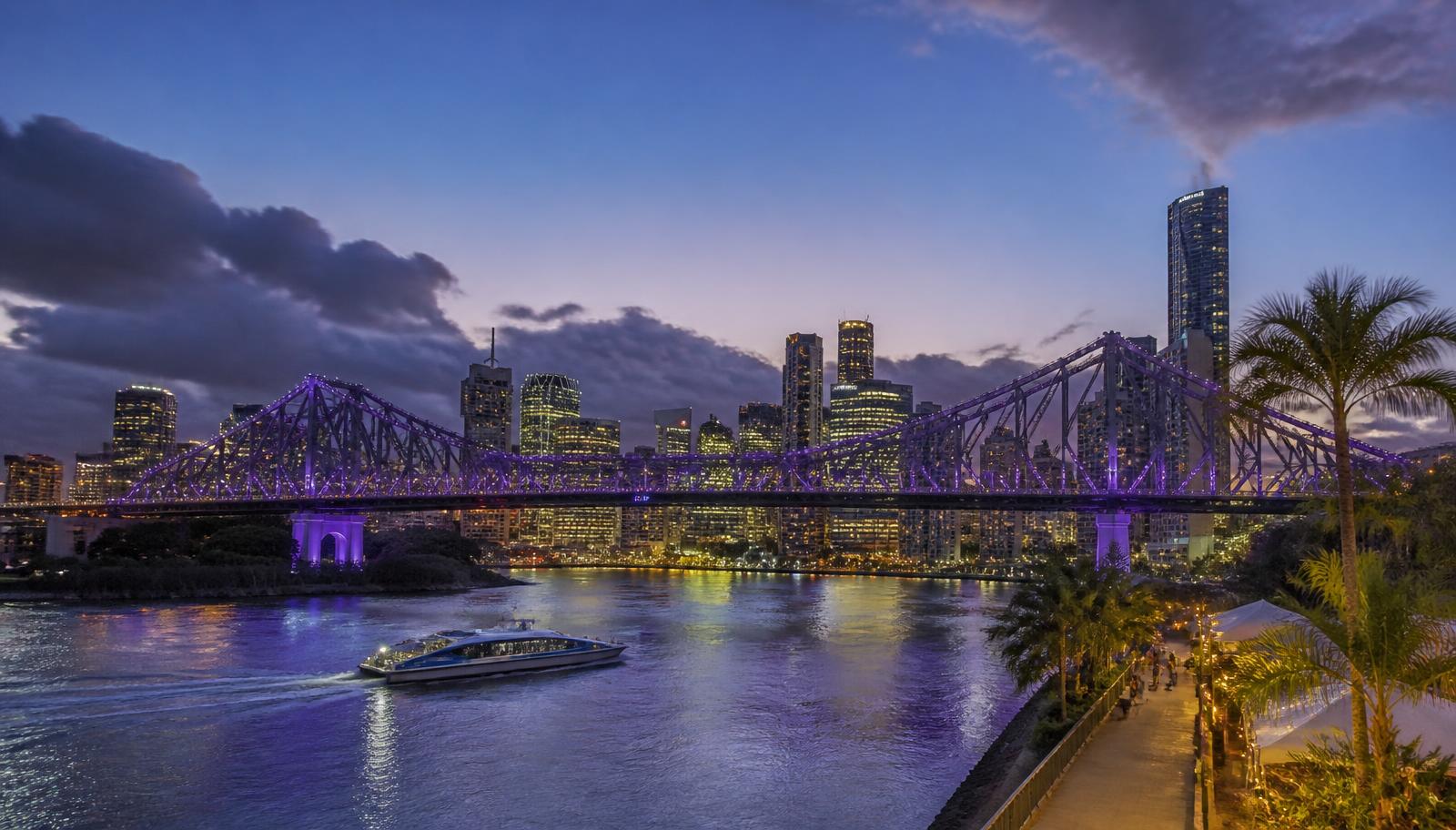
Brisbane at a glance
Brisbane is where a lot of British movers end up when they realise how much of their Sydney salary would go on rent. It is smaller and quieter, built along a winding river, and the climate is the main draw: winter here is what a good British summer looks like. The city has changed rapidly over the last decade, with far more bars, restaurants and cultural venues than its old reputation suggests, and major investment continuing in the run-up to the 2032 Olympic and Paralympic Games. The trade-offs are a smaller job market for specialised corporate roles and a genuinely intense summer — humidity, storms and a real risk of flooding in some low-lying suburbs.
Typical rent
Moderate
Below Sydney and Melbourne, but rising
Job market
Growing
Strong in trades, health, hospitality and logistics
Public transport
Good
Trains, buses, Metro busway and CityCat ferries
Weather
Warm year-round
Humid summers, mild dry winters
Lifestyle
Relaxed and outdoorsy
River, pools, coast trips
Average commute
Around 30 min each way
Shorter than the southern capitals
Best for
Warm weather and value
People who want sun without Sydney prices
Cost level
Moderate
Noticeably cheaper day-to-day than Sydney
Why people choose Brisbane
- Winter is warm — you can swim outdoors most of the year
- Lower rent than Sydney and Melbourne for more space
- The Gold Coast and Sunshine Coast are both about an hour away
- A fast-growing city with major infrastructure and events investment underway
How it scores
- Jobs
- Affordability
- Transport
- Nightlife
- Beaches & outdoors
- Weather
- Student life
- Overall cost
Our editorial rating, comparing this city against the other Australian cities we cover.
Rent and housing
Rent is the single biggest number in your move budget, so start here.
| Property type | Indicative weekly rent | Approx. monthly (GBP) |
|---|---|---|
| Room in a shared house | A$220–A$350 / week | £642 / month |
| Room in a shared apartment | A$250–A$380 / week | £710 / month |
| Studio apartment | A$380–A$500 / week | £991 / month |
| 1-bedroom apartment | A$450–A$620 / week | £1,206 / month |
| 2-bedroom apartment | A$580–A$820 / week | £1,577 / month |
Indicative ranges only — actual prices vary by suburb, property and market conditions. GBP converted at A$1 = £0.52 (indicative, September 2026).
City centre
Brisbane CBD, South Brisbane, West End and Fortitude Valley carry the highest rents, mostly in newer apartment towers.
Further out
Move 8–15 km out — Chermside, Coorparoo, Annerley, Moorooka — and you get a Queenslander-style house or a bigger unit for the price of an inner-city one-bed.
- Rent is quoted weekly; bond is commonly four weeks' rent, lodged with the Residential Tenancies Authority.
- Check flood history before signing anywhere near the river or a creek — Brisbane City Council publishes flood awareness maps.
- Indicative rental prices — actual prices vary by suburb, property and market conditions.
Where to live
The areas most new arrivals in Brisbane end up considering, and who each one actually suits.
Fortitude Valley
Immediately north-east of the CBD
Nightlife, music venues, apartments and creative offices
- Suits:
- Young professionals who want to walk home from a night out
- Transport:
- Fortitude Valley station and frequent buses
- To the CBD:
- 10 min walk
- Food:
- Chinatown Mall, James Street dining
West End
~2 km south-west of the CBD
Alternative, markets, cafés, riverside
- Suits:
- Creatives, students and anyone who wants character
- Transport:
- Buses and CityCat from West End ferry terminals
- To the CBD:
- 10–15 min
- Food:
- Boundary Street — Greek, Vietnamese, vegan
New Farm
~3 km north-east
Leafy, riverside, Art Deco flats and good restaurants
- Suits:
- Professionals and couples
- Transport:
- CityCat and buses
- To the CBD:
- 10–15 min by ferry
- Food:
- Merthyr Village and Brunswick Street
South Brisbane & Highgate Hill
Just across the river
Cultural precinct, parkland, new apartments
- Suits:
- People who want galleries, pools and the CBD in walking distance
- Transport:
- South Bank and South Brisbane stations
- To the CBD:
- Walkable
- Food:
- Little Stanley Street and Grey Street
Paddington & Milton
~2–3 km west
Queenslander cottages, boutiques, hills
- Suits:
- Professionals wanting character housing
- Transport:
- Milton station, buses along Given Terrace
- To the CBD:
- 10 min by train
- Food:
- Given Terrace cafés, Park Road Milton
Toowong & St Lucia
~5 km south-west
University of Queensland, students, riverside walks
- Suits:
- Students and staff at UQ
- Transport:
- Toowong station, CityCat, buses
- To the CBD:
- 10–15 min
- Food:
- Toowong Village and campus cafés
Annerley & Moorooka
~5–7 km south
Quiet, practical, good value, diverse
- Suits:
- Value-focused renters and families
- Transport:
- Buses on the South East Busway; train at Moorooka
- To the CBD:
- 20 min
- Food:
- Moorooka's African and Middle Eastern grocers
Chermside
~10 km north
Large shopping centre, apartments, suburban
- Suits:
- Families and anyone wanting cheaper new-build living
- Transport:
- Busway services to the CBD
- To the CBD:
- 25–30 min
- Food:
- Food courts and suburban restaurants
Coorparoo & Camp Hill
~5 km south-east
Family suburbs with new apartment clusters
- Suits:
- Families and settled couples
- Transport:
- Coorparoo station and buses
- To the CBD:
- 15–20 min
- Food:
- Old Cleveland Road cafés
Wynnum & Manly
~15 km east, on Moreton Bay
Bayside village feel, boats, quiet
- Suits:
- People who want water without inner-city prices
- Transport:
- Cleveland train line
- To the CBD:
- 30–35 min
- Food:
- Bayside cafés and fish and chips
- Beach:
- Bay foreshore and the Wynnum wading pool
Jobs and industries
Brisbane's economy is broader than its reputation. Construction and infrastructure are busy, health and social care is the biggest employer, and mining and resources head offices provide corporate and engineering roles even though the mines are inland. Corporate finance and big-tech roles are thinner than in Sydney, so if that is your field, check the market carefully before committing.
Main industries
- Healthcare & social assistanceLargest employer in Queensland; nurses and allied health in steady demand.
- Construction & infrastructureMajor transport and venue projects, including 2032 Games preparation.
- Mining & resources servicesCorporate, engineering and FIFO support roles based in Brisbane.
- Hospitality & tourismStrong year-round with the coasts nearby.
- Education & trainingSeveral universities plus a large international student sector.
- Logistics & transportPort of Brisbane and the northern industrial corridor.
- Professional servicesSmaller than the southern capitals but growing.
- Public sectorQueensland state government is a large Brisbane employer.
Main business districts
- Brisbane CBD
- Fortitude Valley
- Milton & Toowong
- Herston / RBWH health precinct
- Eagle Farm & the airport corridor
Getting your first job
Hospitality, retail, warehousing, cleaning and construction labouring are the common starting points. Queensland requires an RSA for alcohol service and a White Card for construction site work — both are short courses.
Graduate routes
Queensland Government graduate programmes, health services and the big professional firms all run intakes. Many require permanent residency; confirm eligibility before applying.
Indicative pay
| Role | Indicative range (AUD) | Basis |
|---|---|---|
| Hospitality / bar staff | A$27–A$33 | per hour |
| Barista | A$27–A$34 | per hour |
| Retail assistant | A$26–A$32 | per hour |
| Labourer (White Card) | A$30–A$40 | per hour |
| Receptionist / admin | A$55,000–A$70,000 | per year |
| Graduate (corporate) | A$60,000–A$75,000 | per year |
| Registered nurse | A$72,000–A$100,000 | per year |
| Electrician / plumber | A$80,000–A$120,000 | per year |
| Civil engineer | A$90,000–A$135,000 | per year |
| Software developer | A$85,000–A$130,000 | per year |
Indicative ranges gathered from public job listings and official statistics — actual pay depends on experience, employer, award coverage and visa status. Check the Fair Work Ombudsman for minimum rates.
Getting around
Translink's Go card covers trains, buses, ferries and trams across South East Queensland, and contactless bank cards are also accepted on most services. Queensland has run heavily discounted flat fares in recent years — check the current fare policy, as it can change.
How people travel
- TrainsQueensland Rail lines reach the Gold Coast and Sunshine Coast as well as the suburbs.
- Buses & Brisbane MetroDedicated busways make bus travel genuinely fast across the city.
- CityCat & ferriesRiver ferries that double as the nicest commute in Australia; CityHopper is free.
- CyclingGood riverside bikeways, but the city is hilly and hot for much of the year.
- DrivingTolled tunnels and motorways ring the city; CBD parking is expensive.
Fares, commutes and cars
- Travel card
- Go card
- Fares
- Fares are zone-based via Translink. Confirm current pricing on the Translink site before budgeting.
- Typical commute
- Typically 20–35 minutes from inner and middle suburbs; the busways keep bus commutes competitive with rail.
- Do you need a car?
- You can live without a car in the inner suburbs, but Brisbane is more car-dependent than Sydney or Melbourne, and a car makes coast trips far easier.
- Late night
- NightLink buses and trains run on Friday and Saturday nights from the Valley and the CBD.
Brisbane Airport (BNE)
- Distance
- About 15 km north-east of the CBD
- By train
- The Airtrain runs from both terminals to the CBD and on to the Gold Coast. It carries a premium fare above the standard rail fare.
- By bus
- Limited public bus access; most people use Airtrain, shuttle services or rideshare.
- Taxi & rideshare
- Designated rideshare and taxi pick-up zones at both terminals.
- Journey time
- About 20 minutes by Airtrain to Central; 25–40 minutes by road.
- Cost
- Estimate only: Airtrain costs more than a normal train fare but well under a taxi. Check current prices before travelling.
Monthly cost of living
Three realistic monthly budgets for one person, in Australian dollars. Rent assumes your share of a shared home at the lower end and your own place at the top.
| Monthly expense | Budget | Average | Comfortable |
|---|---|---|---|
| Rent (your share) | A$1,050 | A$1,450 | A$2,100 |
| Groceries | A$360 | A$500 | A$650 |
| Transport | A$90 | A$150 | A$200 |
| Phone | A$25 | A$40 | A$60 |
| Utilities & internet | A$140 | A$210 | A$300 |
| Gym / sport | A$0 | A$60 | A$110 |
| Eating out | A$130 | A$300 | A$550 |
| Entertainment | A$80 | A$180 | A$350 |
| Personal spending | A$90 | A$220 | A$430 |
| Total per month | A$1,965£1,022 | A$3,110£1,617 | A$4,750£2,470 |
Indicative — actual costs vary by household, suburb and lifestyle. GBP converted at A$1 = £0.52 (indicative, September 2026).
Things to do in Brisbane
South Bank Parklands & Streets Beach
Iconic landmark
A man-made lagoon beach in the middle of the city, surrounded by parkland and restaurants. Free to swim.
- Where:
- South Bank
- Cost:
- Free
- Getting there:
- South Bank station or CityCat
Story Bridge
Iconic landmark
The bridge that defines the skyline; walk across it free or book the adventure climb.
- Where:
- Kangaroo Point
- Cost:
- Free to walk; climb ticketed
- Getting there:
- Walk from the CBD or Kangaroo Point
Kangaroo Point Cliffs
Nature
River cliffs used for abseiling and rock climbing, with the best skyline view in the city at night.
- Where:
- Kangaroo Point
- Cost:
- Free
- Getting there:
- CityCat to Thornton Street or walk over the bridge
Lone Pine Koala Sanctuary
Family
One of the oldest koala sanctuaries in the world, reachable by river cruise.
- Where:
- Fig Tree Pocket
- Cost:
- Ticketed
- Getting there:
- Bus 430 or a river cruise from the CBD
Queensland Gallery of Modern Art (GOMA)
Museum
Australia's largest modern art gallery, next to the Queensland Art Gallery and museum.
- Where:
- South Bank
- Cost:
- General entry free
- Getting there:
- South Bank station
Mount Coot-tha Lookout & Botanic Gardens
Nature
The classic city view plus subtropical gardens and a planetarium at the base.
- Where:
- Toowong
- Cost:
- Free
- Getting there:
- Bus 471 from the CBD
New Farm Park & Brisbane Powerhouse
Park
Riverside park with jacarandas and a converted power station running comedy, theatre and markets.
- Where:
- New Farm
- Cost:
- Free park; shows ticketed
- Getting there:
- CityCat to New Farm Park
Eat Street Northshore
Market
Weekend shipping-container food market on the river.
- Where:
- Hamilton
- Cost:
- Small entry fee
- Getting there:
- CityCat to Northshore Hamilton
Moreton Island (Mulgumpin)
Day trip
Sand island with shipwreck snorkelling and dunes, reachable by ferry.
- Where:
- Moreton Bay
- Cost:
- Ferry ticketed
- Getting there:
- Ferry from the Port of Brisbane
North Stradbroke Island (Minjerribah)
Day trip
Surf beaches, whale watching and the North Gorge Walk.
- Where:
- Moreton Bay
- Cost:
- Ferry ticketed
- Getting there:
- Train to Cleveland then ferry
Gold Coast
Day trip
Surfers Paradise, theme parks and long surf beaches, an hour south by train.
- Where:
- About 70 km south
- Cost:
- Train fare; parks ticketed
- Getting there:
- Gold Coast train line then tram
Sunshine Coast & Noosa
Day trip
Calmer beaches, the Noosa National Park coastal walk and hinterland towns.
- Where:
- About 100–140 km north
- Cost:
- Free beaches
- Getting there:
- Sunshine Coast line to Nambour, then bus; car easier
Beaches, parks and the outdoors
Streets Beach, South Bank
- Distance:
- In the city
- Getting there:
- Train or CityCat
- Best for:
- Free swimming in the CBD
- Facilities:
- Lifeguards, showers, cafés
- Atmosphere:
- Busy and family-friendly
Gold Coast beaches
- Distance:
- ~70 km south
- Getting there:
- Train plus tram
- Best for:
- Surf, nightlife, theme parks
- Facilities:
- Full facilities, patrolled beaches
- Atmosphere:
- High-energy holiday strip
Sunshine Coast & Noosa
- Distance:
- ~100–140 km north
- Getting there:
- Train plus bus, or car
- Best for:
- Calmer beaches and coastal walks
- Facilities:
- Patrolled beaches, cafés
- Atmosphere:
- More relaxed than the Gold Coast
Glass House Mountains
- Distance:
- ~70 km north
- Getting there:
- Train to Beerburrum
- Best for:
- Short steep hikes and lookouts
- Facilities:
- Trails, car parks, picnic areas
- Atmosphere:
- Dramatic volcanic peaks
D'Aguilar National Park
- Distance:
- ~30 km north-west
- Getting there:
- Car
- Best for:
- Rainforest walks and mountain biking
- Facilities:
- Visitor centre, marked trails
- Atmosphere:
- Cool and green
Brisbane River bikeways
- Distance:
- Through the city
- Getting there:
- Walk or bike
- Best for:
- Running and riding
- Facilities:
- Riverwalk, drinking fountains, lighting
- Atmosphere:
- Popular early morning and evening
Nightlife, food and going out
Nightlife
Brisbane's nightlife is concentrated rather than spread out, with Fortitude Valley as the main hub and a growing set of small bars and rooftops in the CBD and West End. Queensland's licensing means many venues stop serving earlier than in Melbourne, and there is a lockout in parts of the Valley — check times before planning a late night.
- Fortitude ValleyThe main nightlife precinct — clubs, live music and late bars.
- CBD & Howard Smith WharvesRooftop bars, breweries and riverside drinking under the Story Bridge.
- West EndPubs, live music and a more alternative crowd.
- Caxton Street, Petrie TerraceSport pubs, packed on Broncos and rugby nights.
- James Street, New FarmSmarter bars and restaurants.
Food and coffee
Brisbane's food scene has changed dramatically — riverside dining precincts, a strong brewery culture, and excellent, cheap Asian food. Outdoor eating is realistic almost year-round, which shapes how the city socialises.
- Fortitude Valley ChinatownChinese, Korean and Japanese restaurants, open late.
- Boundary Street, West EndGreek, Vietnamese, Middle Eastern and vegan spots.
- Howard Smith WharvesRiverside restaurants and a large brewery.
- SunnybankWidely regarded as the best Asian food precinct in Brisbane.
- Jan Powers Farmers MarketsWeekend produce markets at the Powerhouse and CBD.
Indicative: coffee A$4.50–A$6, casual lunch A$16–A$25, mid-range dinner with a drink A$40–A$65 per person.
Weather through the year
Warm to hot most of the year; humid summers with storms, mild dry winters
Summer
December–February
Typically high-20s to mid-30s °C
Hot and very humid, with afternoon storms and a wet season. Air conditioning matters.
Autumn
March–May
Typically low-20s to high-20s °C
Humidity drops off — one of the best times of year.
Winter
June–August
Typically 10–22 °C
Dry, sunny days and cool nights. Most people still swim.
Spring
September–November
Typically high-teens to high-20s °C
Warm and dry, building towards storm season.
What to pack from the UK
- You will barely use heavy winter clothing — a hoodie and a light jacket cover Brisbane's winter.
- Bring light, breathable clothing for summer humidity, and expect to do more laundry.
- A good rain jacket and waterproof bag matter in storm season; Brisbane rain is torrential rather than drizzly.
Check the Bureau of Meteorology for current averages, storm warnings and flood information.
Studying in Brisbane
Brisbane has a large student population and lower living costs than Sydney or Melbourne, which makes it a strong value option for study.
Universities and colleges
- University of Queensland (UQ)
- Queensland University of Technology (QUT)
- Griffith University
- Australian Catholic University
- TAFE Queensland
Where students live
St Lucia, Toowong and Indooroopilly suit UQ; Kelvin Grove, Spring Hill and the CBD suit QUT; Nathan, Mount Gravatt and Southport suit Griffith.
Costs and concessions
Share houses are generally much cheaper than purpose-built student accommodation. Concession travel rules differ for international students — check Translink before assuming eligibility.
Healthcare, shopping and practicalities
Healthcare
- GP clinics handle non-urgent care; bulk-billing is less common than it used to be, so expect a gap fee at many practices.
- UK citizens have access under the Reciprocal Health Care Agreement for medically necessary treatment — check Services Australia for what is and is not covered.
- Student visas require Overseas Student Health Cover; other temporary visas usually expect private cover.
- Major public hospitals include the Royal Brisbane and Women's, Princess Alexandra and Queensland Children's.
- Call 000 in an emergency; 13 HEALTH gives free 24-hour phone health advice in Queensland.
- General relocation information only — confirm your own cover with Services Australia and your insurer.
Shopping and setting up
- Supermarkets
- Coles, Woolworths, ALDI and IGA across the city; Sunnybank and Inala have large and cheaper Asian grocers.
- Shopping centres
- Queen Street Mall in the CBD, Westfield Chermside (one of the largest in Australia), Indooroopilly and Carindale.
- Markets
- Jan Powers Farmers Markets, Eat Street Northshore, Davies Park in West End.
- Furnishing a first place
- IKEA at Logan, plus Kmart and Facebook Marketplace for second-hand furniture. Kerbside collection days are worth watching.
Your first week in Brisbane
- 1Get a Go card or confirm your bank card works for tapping on
- 2Buy an Australian SIM or eSIM
- 3Open an Australian bank account
- 4Apply for a Tax File Number (TFN)
- 5Check Medicare eligibility under the UK reciprocal agreement
- 6Get a White Card if you plan to do any construction work
- 7Check flood maps before committing to a rental near the river
- 8Book rental inspections and prepare your application pack
- 9Buy sun cream, a hat and a fan or check the air conditioning works
- 10Take a CityCat down the river to get your bearings — it doubles as the cheapest city tour
Weekend trips from Brisbane
Gold Coast
Day trip
- Distance:
- ~70 km south
- Driving:
- About 1 hour
- Public transport:
- Direct train plus the G:link tram
- Known for:
- Surf beaches, theme parks, nightlife
Sunshine Coast & Noosa
Weekend
- Distance:
- ~100–140 km north
- Driving:
- 1.5–2 hours
- Public transport:
- Train to Nambour then bus
- Known for:
- Beaches, coastal walks, hinterland markets
Byron Bay
Weekend
- Distance:
- ~165 km south
- Driving:
- About 2 hours
- Public transport:
- Coach services
- Known for:
- Surf, lighthouse walk, laid-back town
North Stradbroke Island
Day trip or overnight
- Distance:
- ~50 km east plus ferry
- Driving:
- About 1 hour to Cleveland
- Public transport:
- Train to Cleveland then ferry
- Known for:
- Whale watching, gorge walk, quiet beaches
Scenic Rim & Lamington National Park
Day trip
- Distance:
- ~100 km south
- Driving:
- About 1.5–2 hours
- Public transport:
- Very limited — car needed
- Known for:
- Rainforest walks and waterfalls
Fraser Island (K'gari)
Long weekend
- Distance:
- ~250 km north
- Driving:
- About 3.5 hours to Hervey Bay
- Public transport:
- Coach or flight then tour
- Known for:
- Sand island, lakes, 4WD tours
Is Brisbane right for you?
Pros
- Warm weather almost all year — winter is genuinely pleasant
- Cheaper rent and living costs than Sydney or Melbourne
- Two world-class coastlines within about an hour
- Shorter commutes and a less pressured pace
- Growing fast, with big investment ahead of the 2032 Games
Things to consider
- Summer humidity is intense and takes months to adjust to
- Storms and flooding affect some suburbs — always check flood maps
- Fewer senior corporate and finance roles than Sydney
- Nightlife finishes earlier and is concentrated in one area
- More car-dependent than the southern capitals once you leave the inner ring
You'll love Brisbane if…
- You want warm weather year-round without Sydney prices
- You want the beach to be a weekend habit, not a holiday
- You prefer a mid-sized city with shorter commutes
- You work in trades, healthcare, hospitality or construction
Consider somewhere else if…
- You need the deepest corporate job market — see the guide
- You want culture, live music and walkable city life — see the guide
- You want beaches and sunshine with an even lower cost base — see the guide
Where this information comes from
- Domain Rental Report — Indicative rent ranges
- Residential Tenancies Authority (QLD) — Bond and tenancy rules
- Translink Queensland — Transport modes and fares
- Brisbane City Council flood awareness — Flood risk guidance
- Bureau of Meteorology — Climate and seasonal patterns
- Australian Bureau of Statistics — Employment and earnings context
- Services Australia — Medicare — Healthcare access
Last reviewed 6 September 2026. Figures are indicative and change over time — always check the linked sources before making decisions.
Meeting people and settling in
Brisbane is smaller than the southern capitals, which makes it easier to become a regular somewhere and harder to disappear. Most social life happens outdoors or around sport.
Outdoor fitness groups
Free council-run classes and boot camps run in parks across the city.
Social sport
Touch footy, volleyball and netball leagues run most weeknights.
Run clubs and parkrun
Riverside routes and free weekly 5k events.
Surf and beach trips
Weekend coast trips are the main social ritual — offer to drive or chip in for petrol.
Backpacker and share-house networks
The Valley and West End are the traditional landing spots.
Markets and festivals
Weekend markets, Riverfire and food festivals run year-round.
Volunteering
Community and event volunteering, with more opportunities appearing around the 2032 Games.