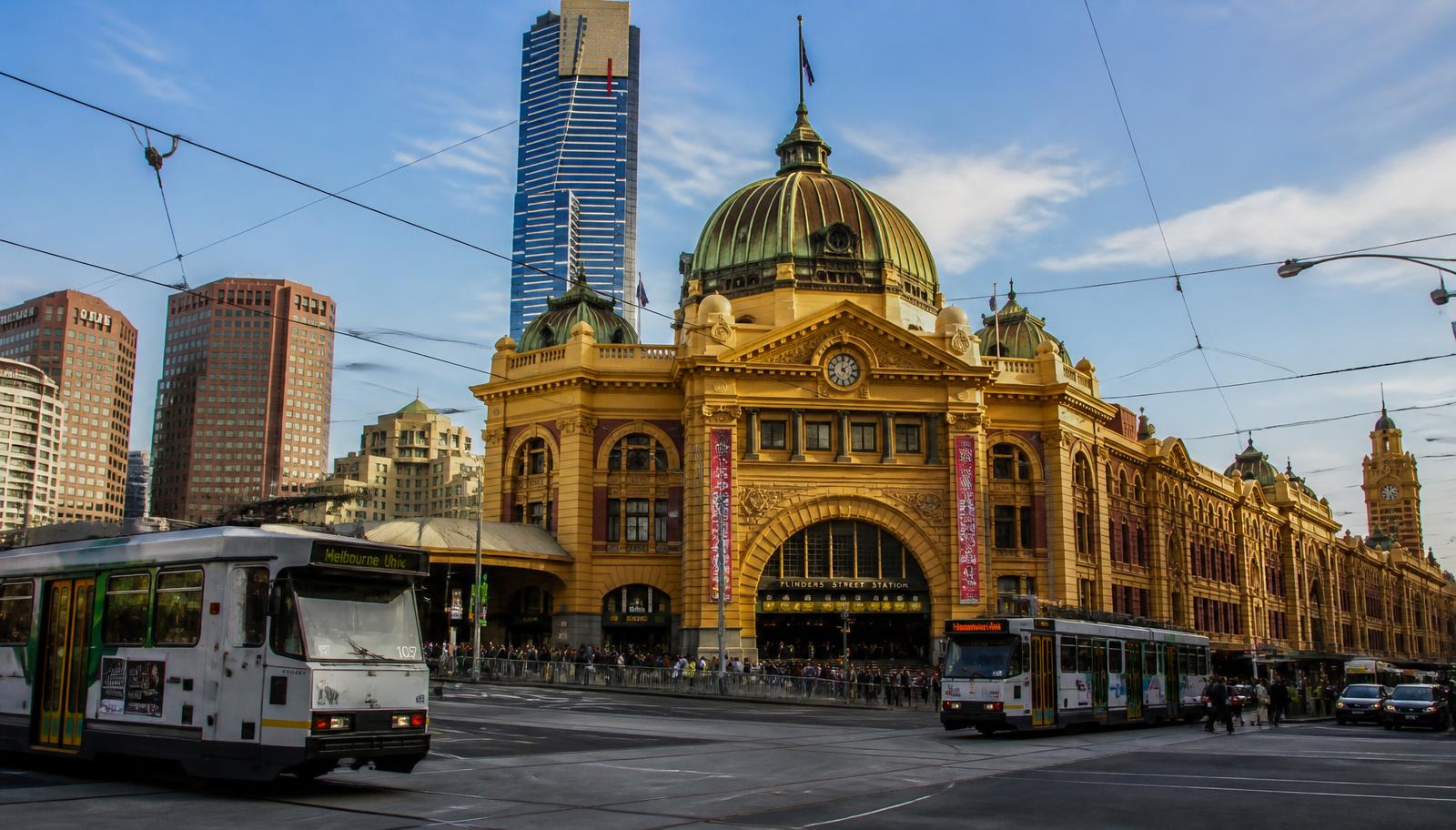
Melbourne at a glance
Melbourne is the city most British arrivals describe as the easiest to settle into. It is dense, walkable and tram-connected in a way that feels closer to a European city than the rest of Australia, and the calendar is packed — the Australian Open, the Grand Prix, the AFL Grand Final, comedy and film festivals, and constant live music. Rent is high but usually below Sydney, and the trade-off is weather: Melbourne is famously changeable and genuinely gets cold in winter by Australian standards. If you came for guaranteed sunshine, this isn't your city. If you came for a life with culture, food and things to do, it very much is.
Typical rent
High
Generally below Sydney for the same property
Job market
Strong
Second-largest employment market in Australia
Public transport
Excellent
Trams, trains and buses; free tram zone in the CBD
Weather
Four seasons in a day
Coolest winters of the big five
Lifestyle
Cultural and social
Bars, galleries, sport, live music
Average commute
Around 30–40 min each way
Shorter if you live inner north or west
Best for
Culture, food, nightlife
People who want a city, not a beach town
Cost level
High
Cheaper than Sydney, dearer than Adelaide
Why people choose Melbourne
- More affordable than Sydney while still a full-scale global city
- The best public transport network in Australia for inner-city living
- Enormous arts, music, food and sport calendar
- Feels familiar to British arrivals — walkable, layered and weather you recognise
How it scores
- Jobs
- Affordability
- Transport
- Nightlife
- Beaches & outdoors
- Weather
- Student life
- Overall cost
Our editorial rating, comparing this city against the other Australian cities we cover.
Rent and housing
Rent is the single biggest number in your move budget, so start here.
| Property type | Indicative weekly rent | Approx. monthly (GBP) |
|---|---|---|
| Room in a shared house | A$250–A$380 / week | £710 / month |
| Room in a shared apartment | A$280–A$420 / week | £789 / month |
| Studio apartment | A$380–A$520 / week | £1,014 / month |
| 1-bedroom apartment | A$430–A$620 / week | £1,183 / month |
| 2-bedroom apartment | A$580–A$850 / week | £1,611 / month |
Indicative ranges only — actual prices vary by suburb, property and market conditions. GBP converted at A$1 = £0.52 (indicative, September 2026).
City centre
CBD, Southbank and Docklands have a lot of high-rise apartment stock, which keeps prices more competitive than Sydney's centre — check building quality and bills carefully.
Further out
The inner north (Brunswick, Coburg, Preston) and the west (Footscray, Yarraville) are the traditional value picks, both well served by trains and trams.
- Rent is advertised weekly; a bond of four weeks' rent is standard in Victoria.
- Victoria has relatively strong renter protections — read Consumer Affairs Victoria's renting pages before signing.
- Indicative rental prices — actual prices vary by suburb, property and market conditions.
Where to live
The areas most new arrivals in Melbourne end up considering, and who each one actually suits.
Fitzroy & Collingwood
Inner north, 2–3 km from the CBD
Street art, vintage shops, bars and record stores
- Suits:
- Creatives and young professionals who want to walk out to nightlife
- Transport:
- Trams along Brunswick and Smith Streets
- To the CBD:
- 10–15 min by tram
- Food:
- Gertrude and Smith Streets — some of the best eating in the city
Brunswick
Inner north, ~5 km
Middle Eastern bakeries, live music, students and young families
- Suits:
- First-timers wanting inner-city life at a slightly lower price
- Transport:
- Upfield train line and the 19 tram
- To the CBD:
- 15–20 min
- Food:
- Sydney Road for cheap eats; Lygon Street for Italian
Carlton
Immediately north of the CBD
Italian heritage, Melbourne Uni, terraces and parks
- Suits:
- Students and academics
- Transport:
- Multiple tram routes
- To the CBD:
- Walkable, 15–20 min
- Food:
- Lygon Street
St Kilda
Bayside, ~6 km south
Beachy, backpacker-heavy, faded-glamour bars and live music
- Suits:
- New arrivals who want a beach and a scene
- Transport:
- Trams 96, 16 and 3a
- To the CBD:
- 20–25 min by tram
- Food:
- Acland and Fitzroy Streets
- Beach:
- St Kilda Beach and the pier
South Yarra & Prahran
Inner south-east
Polished, boutique shopping, gyms and brunch
- Suits:
- Professionals who want a smart address
- Transport:
- Sandringham line and Chapel Street trams
- To the CBD:
- 10–15 min by train
- Food:
- Chapel Street and Prahran Market
Footscray
Inner west, ~6 km
Vietnamese and East African food, fast-changing, good value
- Suits:
- Value-seekers who want to stay close in
- Transport:
- Major train interchange
- To the CBD:
- 10 min by train
- Food:
- Footscray Market and Barkly Street
Richmond
Inner east, ~3 km
Pubs, sport, Victorian terraces, tech offices
- Suits:
- Sport fans and professionals
- Transport:
- Multiple train lines and trams
- To the CBD:
- 5–10 min by train
- Food:
- Victoria Street for Vietnamese; Bridge Road
Northcote & Thornbury
Inner north, ~7 km
Live music, cafés, young families
- Suits:
- People who want Fitzroy's feel with more space
- Transport:
- Mernda train line and the 86 tram
- To the CBD:
- 20 min
- Food:
- High Street bars and restaurants
Docklands & Southbank
Edge of the CBD
High-rise, modern, quieter at night
- Suits:
- Commuters who want new-build convenience
- Transport:
- Free tram zone, Southern Cross station
- To the CBD:
- Walkable
- Food:
- Riverside dining, South Melbourne Market nearby
Box Hill
Eastern suburbs, ~14 km
Large Chinese community, apartments, big shopping centre
- Suits:
- Students and families prioritising value and food
- Transport:
- Lilydale/Belgrave train lines, 109 tram
- To the CBD:
- 25–30 min by train
- Food:
- Exceptional and affordable Chinese food
Jobs and industries
Melbourne's job market is nearly as deep as Sydney's and more varied outside finance. Health, education, government, creative industries and a growing tech sector all hire consistently. Employers still value local experience, so a short hospitality or contract role while you search is common and not held against you.
Main industries
- Healthcare & social assistanceThe largest employing sector in Victoria, with major hospital networks.
- Professional servicesConsulting, law, accounting and marketing concentrated in the CBD.
- EducationSeveral large universities plus a big international student sector.
- TechnologyStartups in Cremorne and Richmond, plus enterprise tech in the CBD.
- Creative & mediaDesign, film, advertising and music — stronger here than anywhere in Australia.
- Retail & hospitalityConstant turnover, and the fastest way into paid work.
- Construction & infrastructureMajor rail and road projects running across the state.
- LogisticsThe Port of Melbourne and western industrial corridor.
Main business districts
- Melbourne CBD
- Cremorne & Richmond
- Parkville medical precinct
- Docklands
- Clayton / Monash precinct
Getting your first job
Hospitality, retail, warehouse and delivery work are widely available. Victoria requires an RSA for alcohol service; short online courses cover it.
Graduate routes
Graduate programmes run in the Victorian public service, health, the big four firms and major banks, with intakes generally opening in the first half of the year. Many require permanent residency — check eligibility before applying.
Indicative pay
| Role | Indicative range (AUD) | Basis |
|---|---|---|
| Hospitality / bar staff | A$28–A$34 | per hour |
| Barista | A$28–A$36 | per hour |
| Retail assistant | A$27–A$32 | per hour |
| Receptionist / admin | A$58,000–A$72,000 | per year |
| Graduate (corporate) | A$62,000–A$80,000 | per year |
| Registered nurse | A$72,000–A$100,000 | per year |
| Software developer | A$90,000–A$140,000 | per year |
| Graphic / UX designer | A$70,000–A$110,000 | per year |
| Construction worker / trade | A$70,000–A$105,000 | per year |
| Primary / secondary teacher | A$78,000–A$112,000 | per year |
Indicative ranges gathered from public job listings and official statistics — actual pay depends on experience, employer, award coverage and visa status. Check the Fair Work Ombudsman for minimum rates.
Getting around
Melbourne uses a Myki card. Contactless bank cards are being rolled out across the network but are not universally accepted, so buy a Myki when you arrive and top it up online or at stations.
How people travel
- TramsThe largest tram network in the world; the CBD has a Free Tram Zone.
- TrainsMetro lines radiate from the City Loop out to the suburbs.
- BusesCover the gaps between tram and train corridors.
- CyclingFlat, with a decent and improving separated bike lane network.
- WalkingThe inner city is genuinely walkable — a real difference from other Australian cities.
- DrivingWatch for hook turns in the CBD and tolled motorways (CityLink, EastLink).
Fares, commutes and cars
- Travel card
- Myki
- Fares
- Fares are zone-based with a daily cap, and weekends have a lower cap. Confirm current fares with Public Transport Victoria before budgeting.
- Typical commute
- 20–35 minutes is typical from the inner suburbs; 45–70 minutes from the outer growth corridors.
- Do you need a car?
- Inner-suburb residents rarely need a car. It becomes more useful in the outer east and south-east, or for weekend trips along the coast.
- Late night
- Night Network trains, trams and buses run through Friday and Saturday nights.
Melbourne Airport (Tullamarine, MEL)
- Distance
- About 23 km north-west of the CBD
- By train
- There is no direct airport rail link yet; a rail line is under construction. Plan on bus or road transport.
- By bus
- SkyBus runs frequently between the airport and Southern Cross Station, with connections to some suburbs.
- Taxi & rideshare
- Taxis and rideshare use designated pick-up areas; there is also Avalon Airport (AVV) further south-west for some domestic and low-cost flights.
- Journey time
- Around 30–45 minutes to the CBD, longer in peak traffic.
- Cost
- Estimate only: SkyBus is considerably cheaper than a taxi or rideshare to the CBD. Check current prices before travelling.
Monthly cost of living
Three realistic monthly budgets for one person, in Australian dollars. Rent assumes your share of a shared home at the lower end and your own place at the top.
| Monthly expense | Budget | Average | Comfortable |
|---|---|---|---|
| Rent (your share) | A$1,200 | A$1,700 | A$2,400 |
| Groceries | A$380 | A$520 | A$680 |
| Transport | A$120 | A$170 | A$210 |
| Phone | A$25 | A$40 | A$60 |
| Utilities & internet | A$130 | A$200 | A$280 |
| Gym / sport | A$0 | A$65 | A$120 |
| Eating out | A$150 | A$340 | A$620 |
| Entertainment | A$90 | A$220 | A$420 |
| Personal spending | A$100 | A$240 | A$470 |
| Total per month | A$2,195£1,141 | A$3,495£1,817 | A$5,260£2,735 |
Indicative — actual costs vary by household, suburb and lifestyle. GBP converted at A$1 = £0.52 (indicative, September 2026).
Things to do in Melbourne
Federation Square & Flinders Street Station
Iconic landmark
The city's meeting point, opposite Melbourne's most photographed building.
- Where:
- CBD
- Cost:
- Free
- Getting there:
- Flinders Street Station
Melbourne laneways (Hosier Lane, Degraves Street)
Iconic landmark
Street art, tiny coffee shops and bars hidden down alleyways — the defining Melbourne experience.
- Where:
- CBD
- Cost:
- Free
- Getting there:
- Walk from Flinders Street
Queen Victoria Market
Market
Historic open-air market for produce, deli goods and souvenirs, with night markets in season.
- Where:
- North of the CBD
- Cost:
- Free entry
- Getting there:
- Tram along Elizabeth Street
National Gallery of Victoria
Museum
Australia's oldest and most visited gallery, across two sites.
- Where:
- St Kilda Road and Federation Square
- Cost:
- General entry free; major exhibitions ticketed
- Getting there:
- Tram to NGV or walk from Flinders Street
Melbourne Cricket Ground (MCG)
Sport
The spiritual home of Australian sport — AFL in winter, cricket in summer, plus tours.
- Where:
- Yarra Park, Richmond
- Cost:
- Match tickets vary; tours ticketed
- Getting there:
- Train to Richmond or Jolimont
Royal Botanic Gardens Victoria
Park
Large landscaped gardens beside the Yarra, with the Tan running track around them.
- Where:
- South Yarra
- Cost:
- Free
- Getting there:
- Tram along St Kilda Road
St Kilda Beach & pier
Beach
Bay beach with a pier, a little penguin colony at dusk and a long promenade.
- Where:
- St Kilda
- Cost:
- Free
- Getting there:
- Tram 96
Great Ocean Road
Day trip
One of the world's great coastal drives, ending at the Twelve Apostles.
- Where:
- West of Melbourne
- Cost:
- Free to drive; tours ticketed
- Getting there:
- Car hire or organised tour
Melbourne Museum & Royal Exhibition Building
Museum
Natural history, Aboriginal culture and a UNESCO-listed exhibition hall.
- Where:
- Carlton
- Cost:
- Ticketed; concessions available
- Getting there:
- Tram 86 or 96
Brighton Bathing Boxes
Iconic landmark
The row of painted beach huts that appears on every Melbourne postcard.
- Where:
- Brighton
- Cost:
- Free
- Getting there:
- Train to Middle Brighton
Yarra Valley
Day trip
Wine region an hour from the city, with cellar doors and hot-air ballooning.
- Where:
- North-east of Melbourne
- Cost:
- Tastings ticketed
- Getting there:
- Car or tour
Phillip Island Penguin Parade
Nature
Little penguins coming ashore at dusk, in a managed viewing area.
- Where:
- About 140 km south-east
- Cost:
- Ticketed
- Getting there:
- Car or tour
Beaches, parks and the outdoors
St Kilda Beach
- Distance:
- ~6 km south
- Getting there:
- Tram 96
- Best for:
- Bay swimming, kitesurfing, sunset walks
- Facilities:
- Cafés, pier, patrolled in summer
- Atmosphere:
- Busy and social
Brighton Beach
- Distance:
- ~11 km south
- Getting there:
- Sandringham train line
- Best for:
- Calm swimming and the bathing boxes
- Facilities:
- Toilets, kiosks, patrolled areas
- Atmosphere:
- Family-friendly
Mornington Peninsula
- Distance:
- ~70 km south-east
- Getting there:
- Train to Frankston then bus; car far easier
- Best for:
- Surf beaches, hot springs, wineries
- Facilities:
- Full tourist facilities
- Atmosphere:
- Weekend escape
Dandenong Ranges
- Distance:
- ~40 km east
- Getting there:
- Train to Belgrave
- Best for:
- Fern gully walks, the 1000 Steps, Puffing Billy railway
- Facilities:
- Cafés, car parks, marked trails
- Atmosphere:
- Cool, green and rainforest-like
Yarra Bend Park
- Distance:
- ~4 km north-east
- Getting there:
- Bus or bike along the river trail
- Best for:
- Running, kayaking and a flying-fox colony
- Facilities:
- Trails, boathouse, picnic areas
- Atmosphere:
- Surprisingly wild for inner city
Werribee & the west
- Distance:
- ~30 km south-west
- Getting there:
- Werribee train line
- Best for:
- Open-range zoo, mansion and gardens
- Facilities:
- Full facilities
- Atmosphere:
- Family day out
Nightlife, food and going out
Nightlife
Melbourne's nightlife lives in laneways, basements and rooftops rather than big clubs on a single strip. Live music is the city's real strength — there are more small venues here than anywhere else in Australia — and last drinks are generally later than in most Australian cities.
- CBD lanewaysHidden cocktail bars, rooftops and late-night venues.
- Fitzroy & CollingwoodPubs, live music, dive bars and Smith Street.
- BrunswickBands, breweries and cheaper drinks.
- Chapel Street, Prahran & WindsorClubs, late bars and a dressier crowd.
- St KildaThe Espy, beach bars and a long-running live music tradition.
- RichmondTraditional pubs, packed on match days.
Food and coffee
Melbourne takes coffee more seriously than any city in the world and it shows — independent roasters everywhere and almost no reason to visit a chain. The food scene is genuinely global, with Greek, Italian, Vietnamese, Chinese, Ethiopian and Middle Eastern communities all shaping the city's everyday eating.
- Lygon Street, CarltonMelbourne's historic Italian strip.
- Victoria Street, RichmondVietnamese restaurants and grocers.
- Sydney Road, BrunswickMiddle Eastern bakeries, kebabs and sweets.
- FootscrayVietnamese and East African food at low prices.
- South Melbourne & Prahran MarketsProduce, delis and market stalls.
Indicative: coffee A$4.50–A$6.50, casual lunch A$16–A$26, mid-range dinner with a drink A$40–A$70 per person. Tipping is not expected.
Weather through the year
The most changeable in Australia — genuinely four seasons in a day
Summer
December–February
Typically mid-20s, with spikes above 35 °C
Dry heat with sudden cool changes; heatwaves happen.
Autumn
March–May
Typically high-teens to mid-20s °C
Widely considered the best season — settled, mild and golden.
Winter
June–August
Typically 6–15 °C
Grey, damp and genuinely chilly — closest to a mild British winter.
Spring
September–November
Typically 12–22 °C
The most unpredictable season; carry layers.
What to pack from the UK
- Bring your UK winter coat — you will use it here, unlike in Brisbane or Perth.
- Layers matter more than anything: 15 °C mornings and 30 °C afternoons happen in the same day.
- Still bring sun protection; the UV is far stronger than the temperature suggests.
Check the Bureau of Meteorology for current averages and forecasts.
Studying in Melbourne
Melbourne is consistently ranked among the world's best student cities, with a huge student population, strong transport and plenty of part-time work.
Universities and colleges
- University of Melbourne
- Monash University
- RMIT University
- Deakin University
- La Trobe University
- Swinburne University of Technology
- Victoria University
Where students live
Carlton, Parkville and the CBD suit Melbourne Uni and RMIT; Clayton and Caulfield suit Monash; Burwood suits Deakin; Bundoora suits La Trobe.
Costs and concessions
Share houses in the inner north are usually cheaper than purpose-built student accommodation. International students in Victoria generally do not get the same travel concessions as domestic students — check PTV before budgeting.
Healthcare, shopping and practicalities
Healthcare
- GP clinics are the entry point for non-urgent care; bulk-billing clinics charge eligible patients nothing, others charge a gap fee.
- UK citizens are covered by a Reciprocal Health Care Agreement for medically necessary care — check the scope on Services Australia, it is narrower than the NHS.
- Student visas require Overseas Student Health Cover; most other temporary visas expect private health cover.
- Victoria has a strong public hospital network including the Parkville medical precinct.
- Call 000 in an emergency; Nurse-on-Call provides free 24-hour health advice by phone in Victoria.
- General relocation information only — confirm your own eligibility with Services Australia.
Shopping and setting up
- Supermarkets
- Coles, Woolworths, ALDI and IGA are everywhere; markets are often cheaper for fruit, veg and meat.
- Shopping centres
- Chadstone is the largest shopping centre in Australia; Melbourne Central, Emporium and Highpoint cover the rest.
- Markets
- Queen Victoria, South Melbourne, Prahran and Footscray markets.
- Furnishing a first place
- IKEA, Kmart and Facebook Marketplace cover a first flat cheaply; Melbourne's hard-rubbish collections are a well-known source of free furniture.
Your first week in Melbourne
- 1Buy a Myki card and register it online so you can recover the balance if you lose it
- 2Get an Australian SIM or eSIM
- 3Open an Australian bank account
- 4Apply for a Tax File Number (TFN) with the ATO
- 5Check Medicare eligibility under the UK reciprocal agreement
- 6Work out your closest tram, train and supermarket
- 7Start rental applications — bring ID, references and proof of income to inspections
- 8Rewrite your CV in the Australian format
- 9Buy warm layers if you arrive between May and September
- 10Pick a free thing to do each weekend: NGV, the botanic gardens, a market
Weekend trips from Melbourne
Great Ocean Road
Weekend
- Distance:
- ~240 km to the Twelve Apostles
- Driving:
- About 4 hours one way
- Public transport:
- Limited — organised tour or car hire
- Known for:
- Coastal cliffs, surf towns, the Twelve Apostles
Mornington Peninsula
Day trip or weekend
- Distance:
- ~70 km south-east
- Driving:
- About 1.5 hours
- Public transport:
- Train plus bus, slow
- Known for:
- Hot springs, wineries, surf beaches
Yarra Valley
Day trip
- Distance:
- ~60 km north-east
- Driving:
- About 1 hour
- Public transport:
- Tour is easiest
- Known for:
- Wineries and ballooning
Phillip Island
Day trip
- Distance:
- ~140 km south-east
- Driving:
- About 2 hours
- Public transport:
- Coach and tours
- Known for:
- Penguin parade, surf beaches, motorsport
Grampians National Park
Weekend
- Distance:
- ~260 km west
- Driving:
- About 3 hours
- Public transport:
- Coach services; car far easier
- Known for:
- Hiking, waterfalls, lookouts
Bright & the alpine region
Long weekend
- Distance:
- ~310 km north-east
- Driving:
- About 3.5 hours
- Public transport:
- Train to Wangaratta then bus
- Known for:
- Snow in winter, cycling and autumn colour
Is Melbourne right for you?
Pros
- Genuinely walkable, tram-connected inner city
- The best arts, music and food scene in Australia
- More affordable than Sydney for similar city living
- Enormous sport calendar, much of it free or cheap to attend
- Familiar feel for British arrivals
Things to consider
- The weather is changeable and winters are grey and cold by Australian standards
- No beach culture on the scale of Sydney, Perth or Brisbane
- Rental competition in the inner suburbs is intense
- The airport has no train link yet
- The city sprawls a long way east and north; outer commutes are long
You'll love Melbourne if…
- You want culture, live music and food more than guaranteed sunshine
- You want to live car-free in a walkable inner city
- You like sport, festivals and having something on every weekend
- You want a big city that still feels a bit European
Consider somewhere else if…
- You want beaches and warmer weather as the priority — see the guide
- You want warm winters and lower rent — see the guide
- You want the lowest cost of living of the major cities — see the guide
Where this information comes from
- Domain Rental Report — Indicative rent ranges
- Public Transport Victoria — Transport modes, Myki and fares
- Consumer Affairs Victoria — renting — Bond and tenancy rules
- Bureau of Meteorology — Climate and seasonal patterns
- Australian Bureau of Statistics — Employment and earnings context
- Fair Work Ombudsman — Hourly pay context
- Services Australia — Medicare — Healthcare access
Last reviewed 6 September 2026. Figures are indicative and change over time — always check the linked sources before making decisions.
Meeting people and settling in
Melbourne is an easy city to meet people in because so much of life happens in public — pubs, gigs, markets and sport. The barrier is winter, when it takes more effort to leave the house.
Join a footy club or supporter group
Picking an AFL team is a genuine social shortcut here.
Social sport leagues
Netball, five-a-side and basketball leagues run year-round indoors.
Live music
Small venues most nights — a low-pressure way to meet people.
Run clubs and parkrun
Free weekly 5k events across the city.
Classes and workshops
Cooking, pottery and language classes fill up fast, especially in winter.
Share housing
Melbourne's share-house culture is strong and one of the fastest routes into a friendship group.
Volunteering at festivals
The comedy, film and music festivals rely on volunteers.