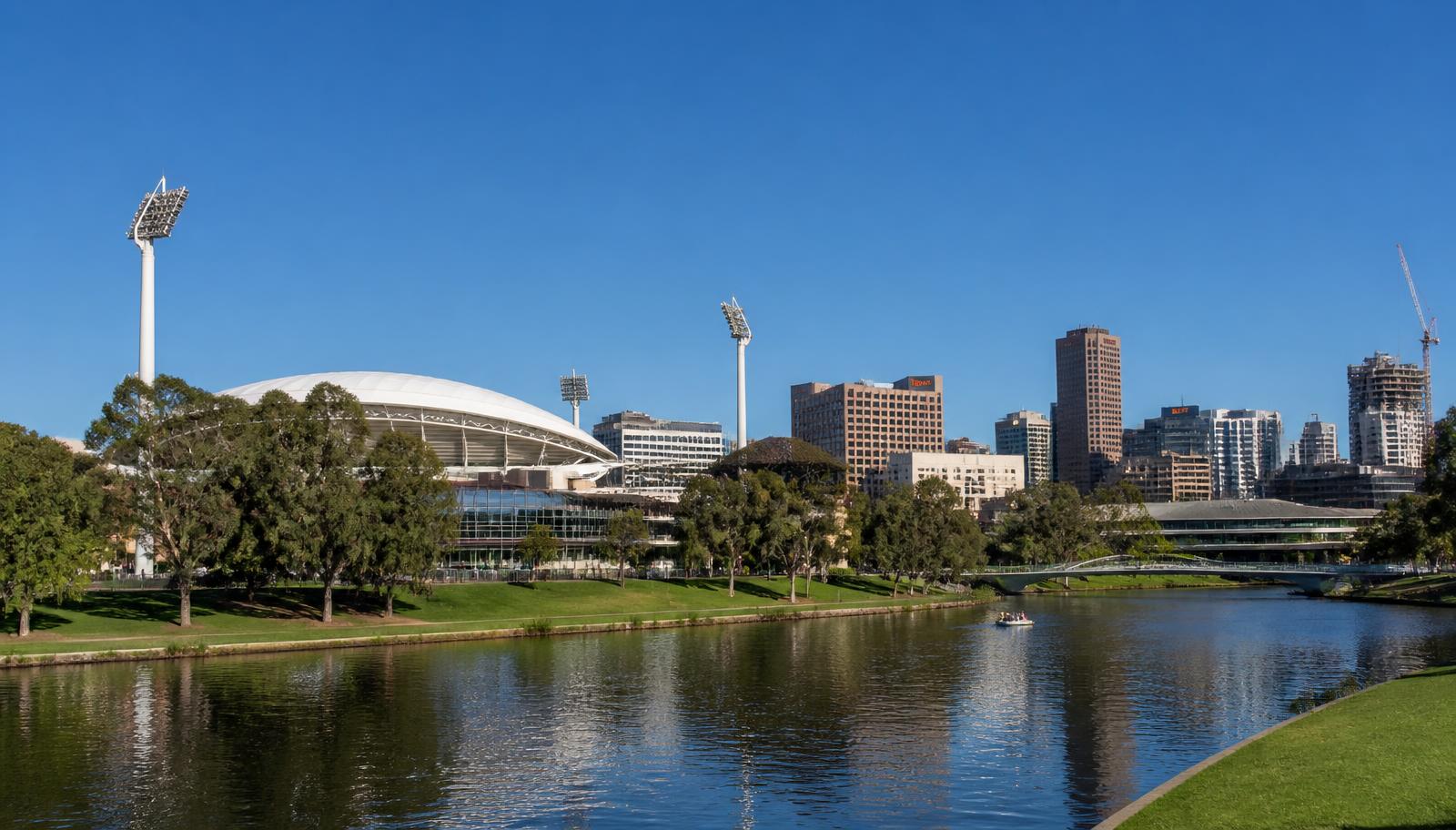
Adelaide at a glance
Adelaide is the city people move to when they want an Australian life without the financial pressure. It is small enough to cross in half an hour, built on a grid surrounded by parkland, and it has a genuinely good food and wine culture because it sits between the Barossa, McLaren Vale and the Adelaide Hills. Rent is the lowest of the major capitals, which changes what a normal salary buys you. The trade-offs are honest: fewer jobs in specialised fields, a quieter nightlife scene, and a slower pace that some new arrivals love and others find limiting after a couple of years. For UK movers on a defined skills pathway, or anyone whose priority is saving and quality of life, it deserves a much closer look than it usually gets.
Typical rent
Lowest of the big five
Rising, but still well below the east coast
Job market
Smaller but steady
Health, defence, education and agriculture
Public transport
Decent
Trams, trains and buses on a metroCARD
Weather
Dry and Mediterranean
Hot dry summers, cool wet winters
Lifestyle
Calm and community-focused
Wine regions, festivals, beaches
Average commute
Around 25 min each way
The shortest of the major cities
Best for
Affordability and quality of life
Savers, families and skilled migrants
Cost level
Lower
The clear value choice of the big five
Why people choose Adelaide
- Your money goes furthest here of any major Australian city
- Beaches, the Adelaide Hills and the Barossa are all around 30–45 minutes away
- Short commutes and almost no traffic by Sydney or Melbourne standards
- South Australia has state-nominated visa pathways aimed at regional and skilled migration
How it scores
- Jobs
- Affordability
- Transport
- Nightlife
- Beaches & outdoors
- Weather
- Student life
- Overall cost
Our editorial rating, comparing this city against the other Australian cities we cover.
Rent and housing
Rent is the single biggest number in your move budget, so start here.
| Property type | Indicative weekly rent | Approx. monthly (GBP) |
|---|---|---|
| Room in a shared house | A$180–A$300 / week | £541 / month |
| Room in a shared apartment | A$210–A$330 / week | £608 / month |
| Studio apartment | A$300–A$420 / week | £811 / month |
| 1-bedroom apartment | A$360–A$500 / week | £969 / month |
| 2-bedroom apartment | A$460–A$650 / week | £1,251 / month |
Indicative ranges only — actual prices vary by suburb, property and market conditions. GBP converted at A$1 = £0.52 (indicative, September 2026).
City centre
The Adelaide CBD, North Adelaide and the inner east carry the highest rents — still modest next to Sydney or Melbourne.
Further out
Beachside suburbs like Glenelg and Henley Beach hold value; northern and southern suburbs such as Salisbury, Elizabeth and Christies Beach are the cheapest, with longer commutes.
- Rent is advertised weekly; bond is generally four weeks' rent (six weeks if rent is above a set threshold) lodged with Consumer and Business Services.
- Adelaide's rental market has tightened in recent years — the days of walking into a cheap house have narrowed.
- Indicative rental prices — actual prices vary by suburb, property and market conditions.
Where to live
The areas most new arrivals in Adelaide end up considering, and who each one actually suits.
Adelaide CBD
The city grid
Compact, walkable, surrounded by parklands
- Suits:
- Students and professionals who want to walk everywhere
- Transport:
- Free City Connector buses, trams, all rail lines
- To the CBD:
- You're in it
- Food:
- Gouger Street, Adelaide Central Market, Peel Street bars
North Adelaide
Just north of the parklands
Bluestone cottages, pubs, leafy and established
- Suits:
- Professionals and couples
- Transport:
- Buses along O'Connell Street
- To the CBD:
- 15 min walk
- Food:
- O'Connell and Melbourne Streets
Glenelg
~11 km south-west, on the coast
Beach town with a tram straight to the city
- Suits:
- Beach-first arrivals
- Transport:
- Glenelg tram
- To the CBD:
- 25–30 min by tram
- Food:
- Jetty Road cafés and restaurants
- Beach:
- Glenelg Beach and the jetty
Henley Beach & Grange
~10 km west
Quieter beach suburbs with a good square of restaurants
- Suits:
- Families and beach lovers
- Transport:
- Buses; Grange train line
- To the CBD:
- 25–30 min
- Food:
- Henley Square
- Beach:
- Henley and Grange beaches
Norwood & Kent Town
~3 km east
The Parade shopping strip, established and social
- Suits:
- Professionals and families
- Transport:
- Frequent buses
- To the CBD:
- 10 min
- Food:
- The Parade — cafés, restaurants and pubs
Prospect & Croydon
~4–5 km north and west
Character housing, cafés, young families
- Suits:
- Couples and families wanting character on a budget
- Transport:
- Buses; Outer Harbor line for Croydon
- To the CBD:
- 15 min
- Food:
- Prospect Road and Queen Street Croydon
Unley & Goodwood
~3 km south
Leafy, heritage villas, cinema and cafés
- Suits:
- Families and professionals
- Transport:
- Buses and the Belair train line
- To the CBD:
- 10–15 min
- Food:
- King William Road and Goodwood Road
Mile End & Thebarton
~3 km west
Industrial-turned-residential, breweries, close to the city
- Suits:
- Value-seekers who want to stay central
- Transport:
- Buses and the Outer Harbor line
- To the CBD:
- 10 min
- Food:
- Henley Beach Road eating strip
Mawson Lakes
~12 km north
Planned modern suburb built around a UniSA campus and lakes
- Suits:
- Students and new-build renters
- Transport:
- Gawler train line
- To the CBD:
- 20–25 min by train
- Food:
- Local centre and campus cafés
Salisbury & Elizabeth
~20–27 km north
Affordable outer suburbs, diverse, house-focused
- Suits:
- Families prioritising space and price
- Transport:
- Gawler train line
- To the CBD:
- 35–45 min
- Food:
- Suburban shopping centres and multicultural grocers
Jobs and industries
Adelaide's job market is smaller, so search strategy matters more than in Sydney. The strongest areas are healthcare, defence (shipbuilding and related engineering), education, agriculture and food production, plus a growing space and advanced-manufacturing cluster. South Australia also runs state nomination programmes for skilled migrants, which can make Adelaide a more realistic visa pathway than the east coast — always confirm current requirements with the Department of Home Affairs and the SA state nomination site.
Main industries
- Healthcare & social assistanceThe largest employer in the state; nursing and aged care in consistent demand.
- Defence & shipbuildingMajor long-term naval and defence programmes based at Osborne.
- Education & researchThree universities plus a strong research sector.
- Agriculture, wine & foodThe Barossa, McLaren Vale, Riverland and Limestone Coast.
- Space & advanced manufacturingThe Australian Space Agency is headquartered in Adelaide.
- ConstructionSteady residential and infrastructure work.
- Hospitality & tourismFestival season and wine tourism drive seasonal demand.
- Public sectorState government is a significant Adelaide employer.
Main business districts
- Adelaide CBD
- Osborne defence precinct
- Lot Fourteen innovation precinct
- Technology Park Mawson Lakes
- Adelaide BioMed City
Getting your first job
Hospitality, retail, aged care support, warehousing and seasonal agricultural work are the usual entry points. RSA certification is required for alcohol service and a White Card for construction sites.
Graduate routes
The SA public sector, health services and defence primes run graduate intakes. Roles in defence often require Australian citizenship and security clearance — check before applying.
Indicative pay
| Role | Indicative range (AUD) | Basis |
|---|---|---|
| Hospitality / bar staff | A$27–A$32 | per hour |
| Retail assistant | A$26–A$31 | per hour |
| Aged care worker | A$28–A$36 | per hour |
| Receptionist / admin | A$52,000–A$66,000 | per year |
| Graduate (corporate/public sector) | A$58,000–A$72,000 | per year |
| Registered nurse | A$70,000–A$98,000 | per year |
| Electrician / plumber | A$75,000–A$110,000 | per year |
| Mechanical engineer (defence) | A$95,000–A$145,000 | per year |
| Software developer | A$80,000–A$120,000 | per year |
| Primary / secondary teacher | A$76,000–A$110,000 | per year |
Indicative ranges gathered from public job listings and official statistics — actual pay depends on experience, employer, award coverage and visa status. Check the Fair Work Ombudsman for minimum rates.
Getting around
Adelaide Metro uses the metroCARD, with contactless bank card payment now accepted on most services. The city centre has free City Connector buses and a free tram zone through the CBD.
How people travel
- TramsOne line running from the CBD out to Glenelg beach — free within the city zone.
- TrainsSix suburban lines radiating north, south and into the hills.
- BusesThe backbone of the network, including the O-Bahn guided busway to the north-east.
- CyclingFlat, quiet and with good bike infrastructure — one of the easier Australian cities to cycle in.
- DrivingEasy by big-city standards, with short journeys and no toll roads in the metro area.
Fares, commutes and cars
- Travel card
- metroCARD
- Fares
- Fares are flat-rate with peak and off-peak pricing, plus free CBD services. Confirm current fares with Adelaide Metro.
- Typical commute
- Typically 20–30 minutes — the shortest average commute of the five major cities.
- Do you need a car?
- Manageable without one if you live on a train or tram line, but a car makes the Hills, wine regions and southern beaches far easier. Running costs are lower than the east coast.
- Late night
- After Midnight bus services run on Saturday nights from the city.
Adelaide Airport (ADL)
- Distance
- About 7 km west of the CBD
- By train
- There is no train to the airport.
- By bus
- The JetBus (Adelaide Metro service) runs between the airport, the city and Glenelg for a standard fare.
- Taxi & rideshare
- Taxi and rideshare pick-up zones sit directly outside the terminal.
- Journey time
- Around 15–25 minutes to the CBD.
- Cost
- Estimate only: the JetBus is a normal Adelaide Metro fare and much cheaper than a taxi. Check current prices before travelling.
Monthly cost of living
Three realistic monthly budgets for one person, in Australian dollars. Rent assumes your share of a shared home at the lower end and your own place at the top.
| Monthly expense | Budget | Average | Comfortable |
|---|---|---|---|
| Rent (your share) | A$850 | A$1,200 | A$1,750 |
| Groceries | A$340 | A$470 | A$620 |
| Transport | A$90 | A$140 | A$200 |
| Phone | A$25 | A$40 | A$60 |
| Utilities & internet | A$140 | A$210 | A$290 |
| Gym / sport | A$0 | A$55 | A$100 |
| Eating out | A$110 | A$250 | A$470 |
| Entertainment | A$70 | A$160 | A$300 |
| Personal spending | A$80 | A$190 | A$380 |
| Total per month | A$1,705£887 | A$2,715£1,412 | A$4,170£2,168 |
Indicative — actual costs vary by household, suburb and lifestyle. GBP converted at A$1 = £0.52 (indicative, September 2026).
Things to do in Adelaide
Adelaide Central Market
Market
One of the largest undercover produce markets in the southern hemisphere, and the heart of the city's food culture.
- Where:
- Adelaide CBD
- Cost:
- Free entry
- Getting there:
- Walk from Victoria Square
Glenelg Beach & the tram
Beach
A beach suburb connected to the city centre by a tram that runs door to sand.
- Where:
- Glenelg
- Cost:
- Free beach
- Getting there:
- Glenelg tram from the CBD
Adelaide Oval & RoofClimb
Sport
One of the world's most attractive cricket grounds, with tours and a roof climb.
- Where:
- North Adelaide
- Cost:
- Match tickets vary; climb ticketed
- Getting there:
- Walk across the footbridge from the CBD
Adelaide Botanic Garden & National Wine Centre
Park
Free gardens beside the city, with wine tasting next door.
- Where:
- North Terrace
- Cost:
- Free garden entry
- Getting there:
- Walk from the CBD
Art Gallery of South Australia
Museum
Major state gallery on the North Terrace cultural boulevard, alongside the SA Museum and State Library.
- Where:
- North Terrace
- Cost:
- General entry free
- Getting there:
- Walk from the CBD
Cleland Wildlife Park
Family
Walk-through wildlife park in the Adelaide Hills where you can get close to kangaroos and koalas.
- Where:
- Adelaide Hills
- Cost:
- Ticketed
- Getting there:
- Car, or bus to Crafers then shuttle
Mount Lofty Summit
Nature
Views back over the whole city, reached by a well-known hike from Waterfall Gully.
- Where:
- Adelaide Hills
- Cost:
- Free
- Getting there:
- Car, or the Waterfall Gully to Mount Lofty walking trail
Barossa Valley
Day trip
One of the world's great wine regions, an hour from the city.
- Where:
- About 60 km north-east
- Cost:
- Tastings ticketed
- Getting there:
- Car or organised tour
McLaren Vale
Day trip
Wine region close to the southern beaches, easy to combine into one day.
- Where:
- About 40 km south
- Cost:
- Tastings ticketed
- Getting there:
- Car, or train to Seaford then a short drive
Hahndorf
Historic district
Australia's oldest surviving German settlement, in the Adelaide Hills.
- Where:
- Adelaide Hills
- Cost:
- Free to visit
- Getting there:
- Bus 864 from the city, or car
Kangaroo Island
Day trip
Wildlife, cliffs and empty beaches, reached by ferry from Cape Jervis.
- Where:
- About 110 km south plus ferry
- Cost:
- Ferry ticketed
- Getting there:
- Drive to Cape Jervis then SeaLink ferry
Adelaide Festival & Fringe
Festival
In February and March the whole city turns into a festival — the Fringe is one of the largest in the world.
- Where:
- Citywide
- Cost:
- Many free events; shows ticketed
- Getting there:
- Citywide venues
Beaches, parks and the outdoors
Glenelg Beach
- Distance:
- ~11 km south-west
- Getting there:
- Tram from the CBD
- Best for:
- Swimming and sunset
- Facilities:
- Patrolled, jetty, cafés
- Atmosphere:
- Busy and family-friendly
Henley & Grange
- Distance:
- ~10 km west
- Getting there:
- Bus or Grange train line
- Best for:
- Quieter swimming and dinner by the sand
- Facilities:
- Squares of restaurants, playgrounds
- Atmosphere:
- Local and relaxed
Semaphore & Largs Bay
- Distance:
- ~15 km north-west
- Getting there:
- Outer Harbor train line
- Best for:
- Long flat beaches and old-fashioned seaside charm
- Facilities:
- Kiosks, jetty, playgrounds
- Atmosphere:
- Quiet, especially midweek
Adelaide Hills
- Distance:
- ~20–30 km east
- Getting there:
- Belair train line or bus
- Best for:
- Hiking, waterfalls, cellar doors
- Facilities:
- Trails, villages, cafés
- Atmosphere:
- Cool, green and a real change of scene
Belair National Park
- Distance:
- ~13 km south-east
- Getting there:
- Belair train line direct to the park
- Best for:
- Walking and mountain biking
- Facilities:
- Trails, picnic areas, playgrounds
- Atmosphere:
- Easy nature without a car
Adelaide Parklands
- Distance:
- Ringing the CBD
- Getting there:
- Walk
- Best for:
- Running, sport and picnics
- Facilities:
- Sports grounds, paths, gardens
- Atmosphere:
- The city's shared back garden
Nightlife, food and going out
Nightlife
Adelaide's nightlife is small-bar led rather than club led, thanks to licensing reforms that filled the CBD's laneways with intimate venues. It peaks dramatically in February and March during Fringe and festival season, when the city genuinely feels twice its size.
- Peel & Leigh StreetsThe city's small-bar heartland.
- Hindley StreetLater clubs, student nights and cheap drinks.
- Rundle Street EastPubs and restaurants with outdoor tables.
- Norwood (The Parade)Local pubs and bars with an older crowd.
- GlenelgBeachfront pubs, busiest in summer.
- The Garden of Unearthly DelightsThe Fringe hub during festival season.
Food and coffee
Adelaide is arguably the best-value food and wine city in Australia. The Central Market anchors it, the wine regions are close enough to be a weeknight drive, and Gouger Street offers a dense run of affordable Asian restaurants.
- Adelaide Central MarketProduce, delis, cheap lunches and coffee.
- Gouger Street & ChinatownChinese, Malaysian, Vietnamese and Japanese restaurants.
- Rundle Street & Ebenezer PlaceRestaurants, wine bars and cafés.
- The Parade, NorwoodItalian delis, cafés and pubs.
- Barossa & McLaren ValeCellar doors with long lunches, within an hour.
Indicative: coffee A$4.50–A$6, casual lunch A$15–A$24, mid-range dinner with a drink A$38–A$60 per person.
Weather through the year
Dry warm summers, cool wet winters — Australia's driest capital
Summer
December–February
Typically high-20s to mid-30s °C, with 40 °C+ spells
Hot and very dry — a dry heat that is easier than Brisbane's humidity but fiercer at its peak.
Autumn
March–May
Typically high-teens to high-20s °C
Mild, settled and comfortable — festival season weather.
Winter
June–August
Typically 8–16 °C
Cool and damp, with most of the year's rain. Cold indoors without heating.
Spring
September–November
Typically mid-teens to mid-20s °C
Green hills, warming steadily, and the nicest time for wine regions.
What to pack from the UK
- Bring a warm jumper and a coat for winter — Adelaide gets colder than people expect.
- Summer needs light clothes, high-factor sun cream and a plan for heatwave days.
- Layers work best year-round; mornings and evenings swing a long way from the daytime peak.
Check the Bureau of Meteorology for current averages, heat warnings and fire danger ratings.
Studying in Adelaide
Adelaide markets itself as one of Australia's most affordable student cities, and the numbers back that up — accommodation and living costs are meaningfully lower than Sydney or Melbourne.
Universities and colleges
- University of Adelaide
- University of South Australia (UniSA)
- Flinders University
- Torrens University Australia
- TAFE SA
Where students live
The CBD, North Adelaide and Unley suit the University of Adelaide and UniSA city campuses; Bedford Park and Tonsley suit Flinders; Mawson Lakes suits UniSA's northern campus.
Costs and concessions
Share housing in the inner suburbs is usually the cheapest route. South Australia has offered travel concessions to international students — check Adelaide Metro for current rules.
Healthcare, shopping and practicalities
Healthcare
- GP clinics handle non-urgent care; bulk-billing is more common here than in some other capitals, but not guaranteed.
- UK citizens are covered for medically necessary treatment under the Reciprocal Health Care Agreement — check Services Australia for the scope.
- Student visas require Overseas Student Health Cover; most other temporary visas expect private cover.
- Major public hospitals include the Royal Adelaide, Flinders Medical Centre and the Women's and Children's.
- Call 000 in an emergency; healthdirect provides free 24-hour phone health advice nationally.
- General relocation information only — confirm your own eligibility with Services Australia.
Shopping and setting up
- Supermarkets
- Coles, Woolworths, ALDI, IGA and Foodland (a strong South Australian chain). The Central Market is often cheaper for fresh produce.
- Shopping centres
- Rundle Mall in the CBD, Westfield Marion, Tea Tree Plaza and Burnside Village.
- Markets
- Adelaide Central Market, Adelaide Showground Farmers Market, Willunga Farmers Market.
- Furnishing a first place
- IKEA at Adelaide Airport, plus Kmart and Facebook Marketplace. Second-hand furniture is noticeably cheaper here than on the east coast.
Your first week in Adelaide
- 1Get a metroCARD or check your bank card taps on
- 2Buy an Australian SIM or eSIM
- 3Open an Australian bank account
- 4Apply for a Tax File Number (TFN)
- 5Check Medicare eligibility under the UK reciprocal agreement
- 6If you're on a skilled route, read the current South Australia state nomination requirements
- 7Book rental inspections and get your application documents together
- 8Walk the Central Market and do your first big shop there
- 9Take the tram to Glenelg to get your bearings and see the coast
- 10Check heating and cooling in any rental before you sign — it matters in both seasons here
Weekend trips from Adelaide
Barossa Valley
Day trip
- Distance:
- ~60 km north-east
- Driving:
- About 1 hour
- Public transport:
- Limited bus; tours are easier
- Known for:
- Shiraz, cellar doors, long lunches
McLaren Vale & Willunga
Day trip
- Distance:
- ~40 km south
- Driving:
- About 45 min
- Public transport:
- Train to Seaford then bus
- Known for:
- Wine, farmers market, nearby beaches
Adelaide Hills & Hahndorf
Day trip
- Distance:
- ~30 km east
- Driving:
- About 30 min
- Public transport:
- Bus 864
- Known for:
- German village, cellar doors, walking trails
Kangaroo Island
Weekend
- Distance:
- ~110 km south plus ferry
- Driving:
- About 1.5 hours to Cape Jervis
- Public transport:
- Coach and ferry packages
- Known for:
- Wildlife, cliffs, empty beaches
Fleurieu Peninsula (Victor Harbor)
Day trip
- Distance:
- ~85 km south
- Driving:
- About 1.25 hours
- Public transport:
- Coach services
- Known for:
- Granite Island, whale watching in season
Flinders Ranges
Long weekend
- Distance:
- ~450 km north
- Driving:
- About 5 hours
- Public transport:
- Tours only
- Known for:
- Outback gorges, Wilpena Pound, stargazing
Is Adelaide right for you?
Pros
- The lowest living costs of Australia's major cities
- Beaches, hills and world-class wine regions all within 45 minutes
- Very short commutes and light traffic
- A packed festival season that transforms the city each February and March
- State nomination pathways that can make skilled migration more achievable
Things to consider
- A smaller job market — specialised roles can be hard to find
- Quieter nightlife outside festival season
- Fewer direct international flights than Sydney or Melbourne
- Summers include severe heatwaves and regional fire risk
- Some new arrivals find the pace too slow after a couple of years
You'll love Adelaide if…
- You want to actually save money while living in Australia
- You like wine regions, festivals and a compact walkable city
- You want a short commute and a calmer daily rhythm
- You're exploring skilled or state-nominated visa routes
Consider somewhere else if…
- You need the biggest job market and the most career options — see the guide
- You want a bigger cultural and nightlife scene year-round — see the guide
- You want warm weather all year with beaches nearby — see the guide
Where this information comes from
- Domain Rental Report — Indicative rent ranges
- Consumer and Business Services SA — renting — Bond and tenancy rules
- Adelaide Metro — Transport modes, metroCARD and fares
- Migration South Australia — State nomination context
- Bureau of Meteorology — Climate and seasonal patterns
- Australian Bureau of Statistics — Employment and earnings context
- Services Australia — Medicare — Healthcare access
Last reviewed 6 September 2026. Figures are indicative and change over time — always check the linked sources before making decisions.
Meeting people and settling in
Adelaide is small enough that you bump into the same people, which cuts both ways — it takes a little longer to break in, but once you do the friendship groups are solid.
Local sport clubs
Footy, netball, cricket and hockey clubs are the traditional social backbone.
Festival volunteering
Fringe, Adelaide Festival and WOMADelaide all take large volunteer teams.
Wine region day trips
Weekend cellar-door trips are the standard Adelaide social outing.
Run clubs and parkrun
Free weekly 5k events across the metro area.
Community and hobby groups
Adelaide punches above its weight for choirs, makerspaces and community gardens.
Share housing
Cheaper than the east coast and still the quickest route into a friendship group.
University and TAFE societies
Open to more than just students in many cases.